
The starting point
Choose a manageable level.
Gluteal tendinopathy affects the tendons attaching the buttock muscles to the outside of the hip. It can make walking, stairs and lying on that side painful. Greater trochanteric pain syndrome (GTPS) is a broader term that can also include nearby bursal irritation. Hip-joint and back problems can cause similar symptoms, so an assessment helps choose the right programme.
The LEAP clinical trial supports education about tendon loading together with individually progressed exercise. Overall improvement was better than with a steroid injection at 52 weeks, although pain intensity was not significantly different then. This supports an approach to care; it does not establish these four exercises or one dosage as best for everyone. Read the clinical trial.
These movements adapt a moderate-level GTPS sheet. Start with one or two suitable options, particularly if pain is easily aggravated. This is not a post-operative hip programme; follow your surgical or treating team's restrictions where relevant.
- Avoid prolonged leg crossing and resting your bodyweight on one hip when these positions provoke pain.
- Try lying on your back, or on the more comfortable side with a pillow supporting the upper leg between the knees and ankles.
- Temporarily reduce hills, stairs or walking distance if they repeatedly flare symptoms. Keep up shorter, manageable activity instead of stopping everything.
Before you start
Choose a load your hip can recover from.
The amounts below are conservative starting examples. Begin with one set of 5–8 slow repetitions of selected exercises on alternate days, leaving a rest day between these strengthening sessions. A clinician may prescribe a different frequency or starting level. You do not need to complete all four together.
Keep any discomfort mild and manageable. Reduce the movement, band tension, repetitions or frequency if pain builds, causes a limp, disturbs sleep or remains clearly worse the next day. Stop and seek advice for sharp pain or continuing deterioration. A painful exercise is not automatically a sign of useful loading.
Seek urgent GP or NHS 111 advice for a suddenly hot or swollen hip, fever or feeling unwell, or severe pain beginning without an injury. Go to A&E for severe pain after a fall or injury, inability to walk or bear weight, or loss of feeling after injury; call 999 if you need emergency assistance. Persistent or worsening symptoms need assessment.
Exercise 1 of 4
Lying hip abduction with a light band
Introduce outer-hip muscle work while the body is supported.
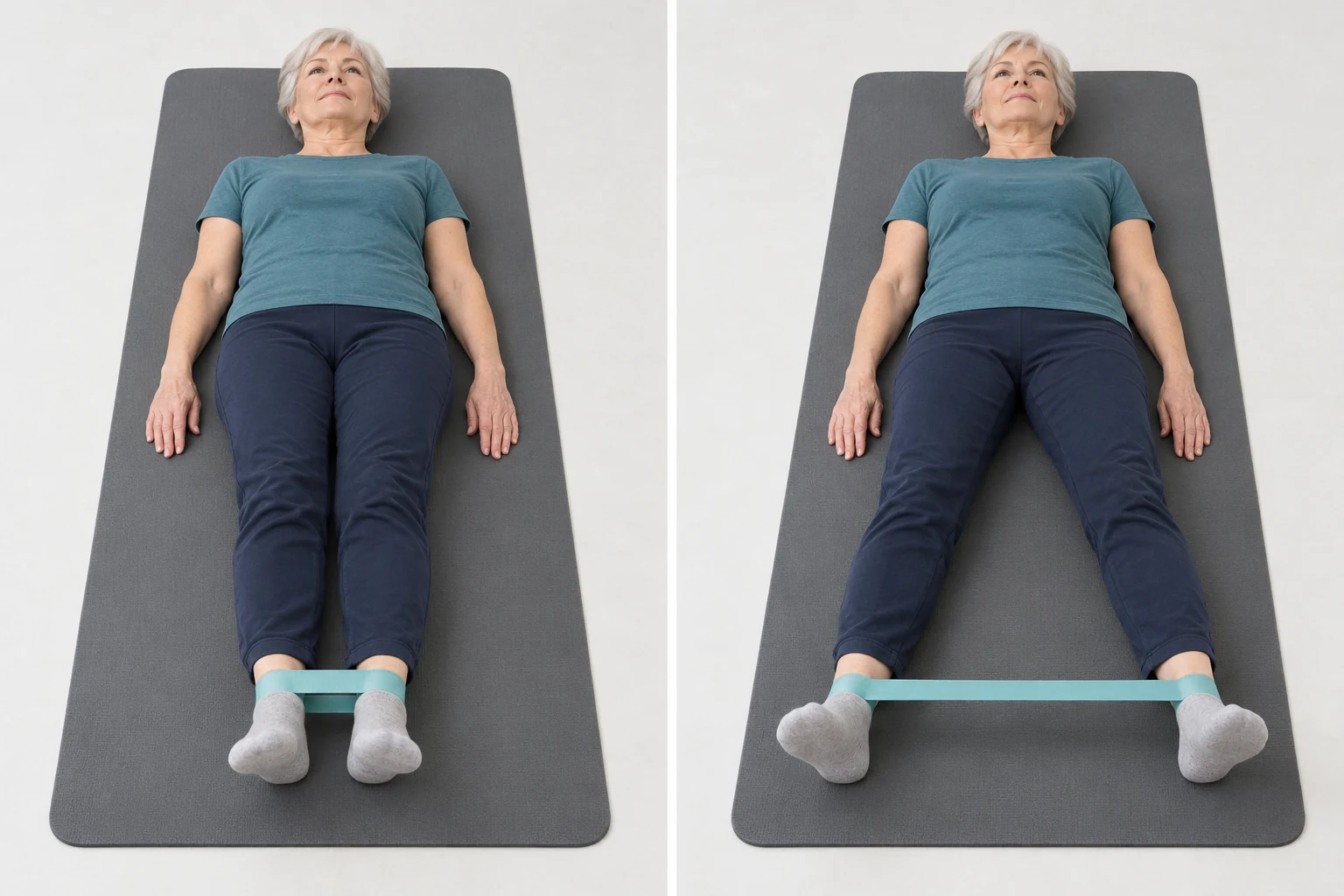
- Lie on your back on a firm bed or mat you can get onto safely. Keep your legs straight, toes pointing upwards and a light loop band around your ankles.
- Start with the feet roughly hip-width apart. Slide the legs a little further apart against the band without rolling the pelvis or turning the feet out.
- Return slowly to the starting width. Keep the legs supported rather than lifting them into the air.
Make it fit: Use a lighter band, a shorter movement or no band. Do not force the legs wide to create a stretch.
- Starting amount
- 1 set
- Repetitions / time
- 5–8
- Frequency
- Alternate days to start
Exercise 2 of 4
Chair squat
Build hip and leg strength for getting up from a chair.
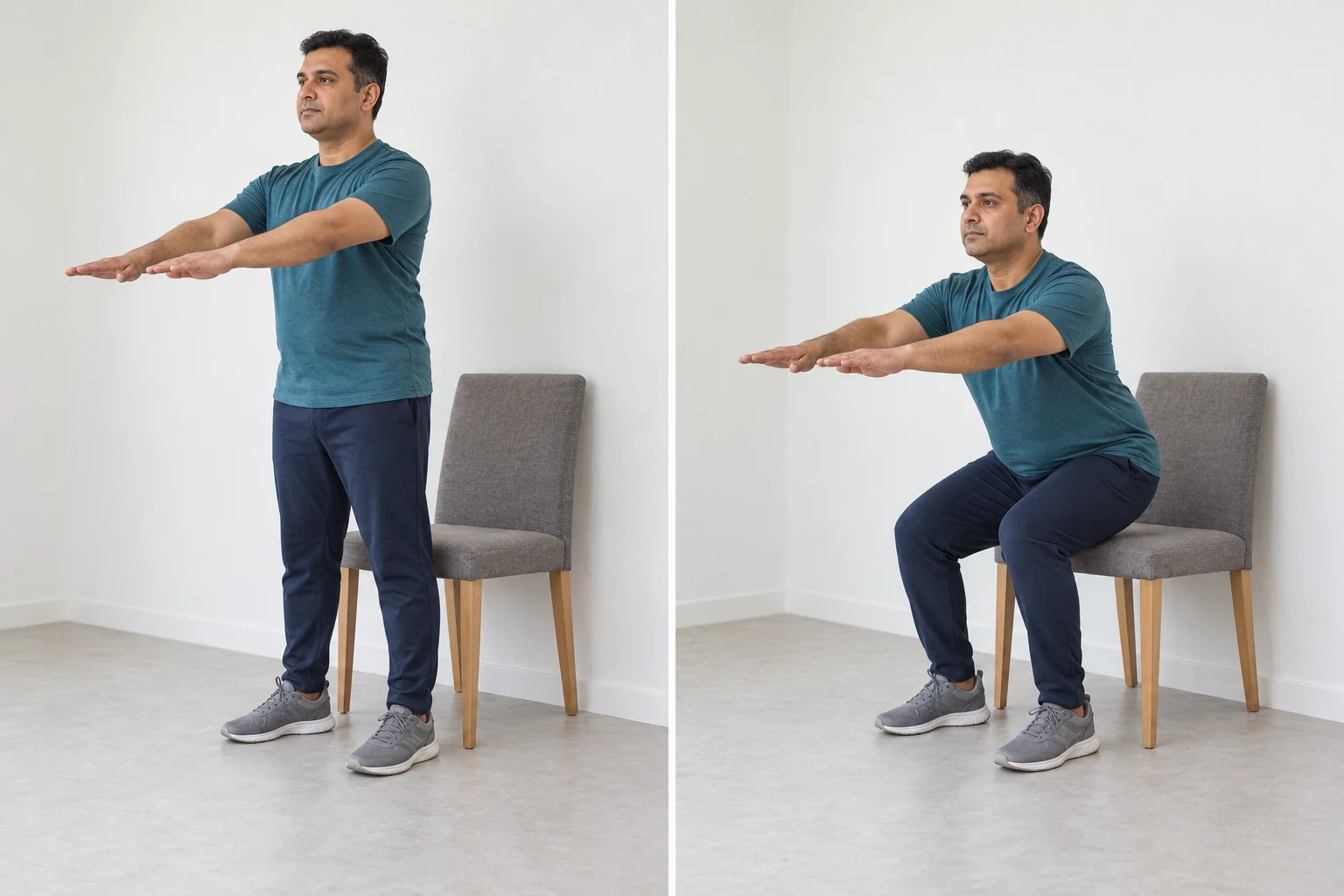
- Use a firm chair secured against a wall. Stand just in front of it with your feet about hip-width apart.
- Move your hips backwards and bend the knees to lower towards the seat. A natural forward lean is fine; keep the knees in line with the feet.
- Touch the seat lightly, then stand again. Sit fully between repetitions if that is more manageable.
Make it fit: Choose a higher seat and use your hands for assistance if needed. Keep weight shared between both legs.
- Starting amount
- 1 set
- Repetitions / time
- 5–8
- Frequency
- Alternate days to start
Exercise 3 of 4
Supported quarter lunge
Practise controlled hip and leg loading in a stepping position.
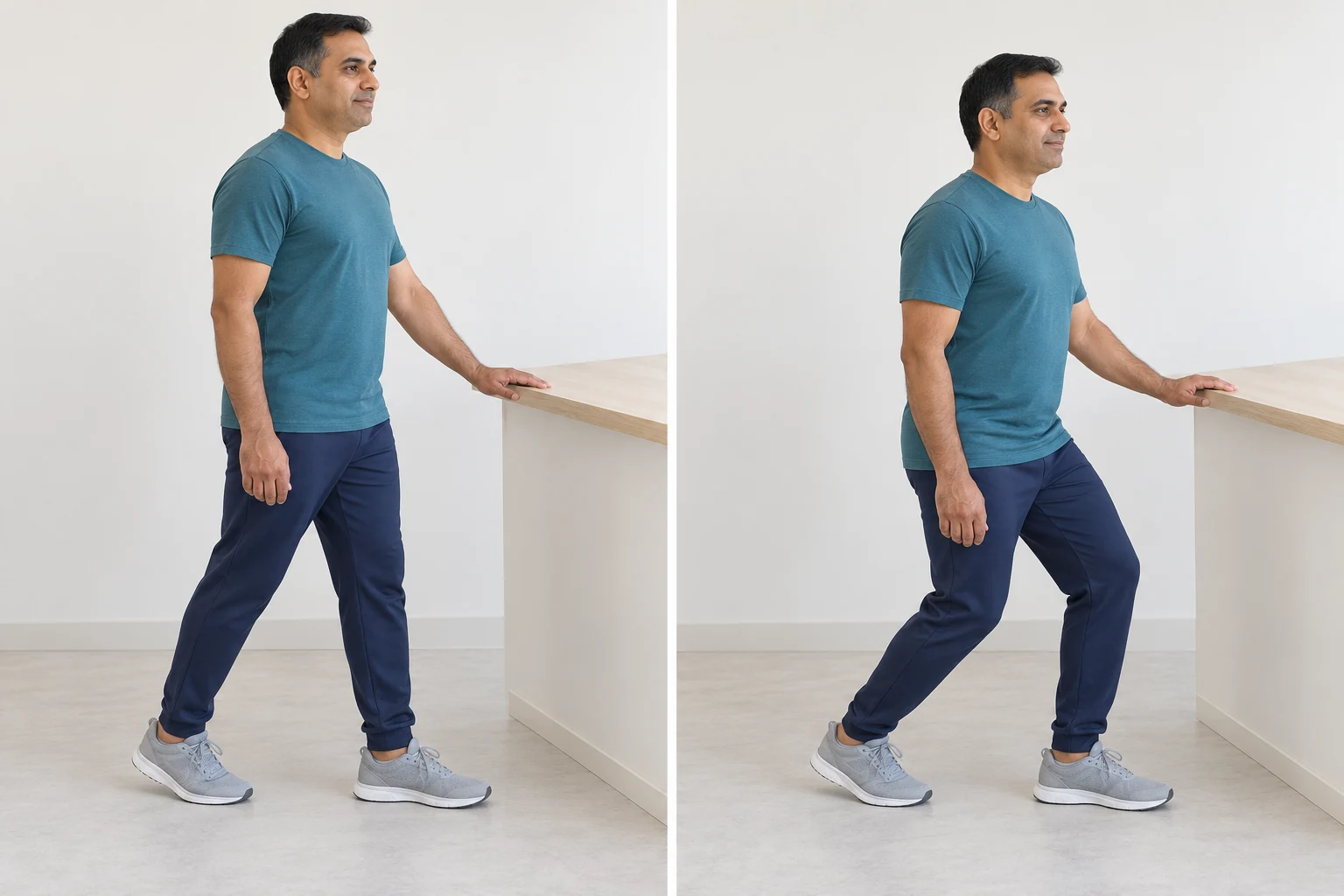
- Stand beside a stable counter and use a light hand support. Place one foot forwards with some width between the feet, rather than standing on a tightrope.
- Bend both knees a little, keeping the front heel down and pelvis level. Let the front knee track in the direction of the toes.
- Push through your feet to return to standing. Keep the movement shallow; the back knee does not need to approach the floor.
Make it fit: Reduce the depth or use the chair squat instead if balance or hip pain makes this difficult.
- Starting amount
- 1 set
- Repetitions / time
- 5–8 each side
- Frequency
- Alternate days to start
Exercise 4 of 4
Supported standing hip abduction
Build control of the outer-hip muscles during standing.
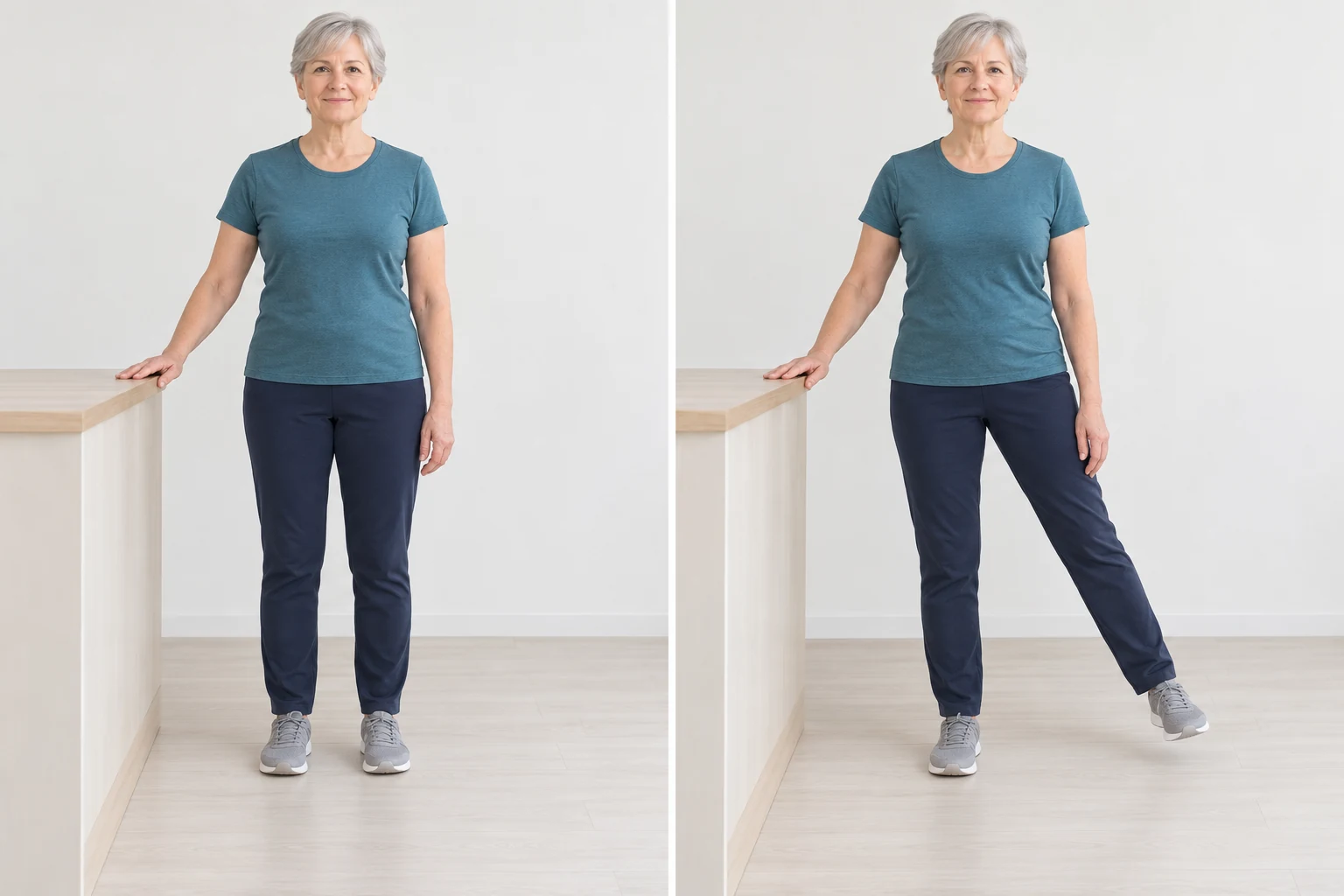
- Stand upright holding a stable counter, with your feet under your hips and knees relaxed.
- Move one leg a short way out to the side with the toes facing forwards. Keep the trunk upright and avoid dropping or hitching the pelvis.
- Return slowly to the starting point without crossing the leg in front of the other. Repeat on the other side if appropriate.
Make it fit: The supporting hip also works. Use more hand support, reduce repetitions or try the lying exercise if standing on the sore side provokes pain.
- Starting amount
- 1 set
- Repetitions / time
- 5–8 each side
- Frequency
- Alternate days to start
Progression
Increase capacity gradually.
Once the starting amount is manageable over several sessions and the hip settles by the following day, build towards 10–15 repetitions, then consider a second set or slightly more resistance. Increase one feature at a time. Recovery commonly takes months, so judge the trend rather than a single session.
Progress should support a useful goal such as walking further, climbing stairs, getting out of a chair or returning to sport. If pain keeps flaring or function is not improving, review the exercise choice, overall activity and diagnosis. Read about hip pain assessment and treatment in Hull.
Resolve MSK Clinic · Hull & East Riding
Build a programme around your everyday activities.
At 44 Bond Street, Hull, assessment considers your symptoms, movement, strength and the demands of work, home or sport. We can adjust exercise selection, check technique and plan progression around your goals.
See what an appointment involves on our private physiotherapy in Hull page, or find the clinic on Bond Street.
Sources and image credits
Where this advice comes from.
Exercise selection adapted from CHCP MSK Physiotherapy: GTPS exercises – MODERATE, dated 15 January 2024, supplied for this guide. Instructions have been rewritten and the starting dose adjusted. The images are newly AI-generated demonstrations using fictional adult models, not the original Rehab My Patient photographs or people in the supplied sheet.
The original sheet lists 3 sets of 5–15 repetitions on 5–7 days each week. The lower starting amounts here are adaptations for general advice, not a copy of the LEAP trial programme or a replacement for an individual prescription.
- Mellor et al. (2018): education and exercise for gluteal tendinopathy, LEAP randomised trial
- Royal National Orthopaedic Hospital: gluteal tendinopathy and activity modification
- Norfolk & Waveney Community MSK: gluteal tendinopathy and response to loading
- NHS: hip pain and when to seek urgent assessment
Evidence and source sheets checked 5 October 2026. General information, not an individual diagnosis or prescription. Review due October 2027, or sooner if guidance materially changes.