
The quick answer
Regular exercise matters, but the right starting point differs from person to person.
NICE recommends therapeutic exercise tailored to the individual for osteoarthritis. These three exercises are practical starting examples rather than a complete programme or a substitute for assessment. Your range, dosage and progression should reflect your pain, swelling, strength and the activities you want to regain.
Before you start
Use a comfortable range and judge the response afterwards.
A brief or mild increase in discomfort can occur during or after exercise. It should settle rather than become steadily worse or continuous. Reduce the range or repetitions if needed. Stop the exercise and seek advice if it causes a marked increase in pain, swelling or loss of function.
A suddenly hot or very swollen knee, fever, a significant recent injury or inability to bear weight needs appropriate medical assessment rather than simply pushing on with exercises.
Complete 2 sets of 15-20 repetitions twice daily.
Exercise 1 · Knee movement
Supine knee flexion: heel slide
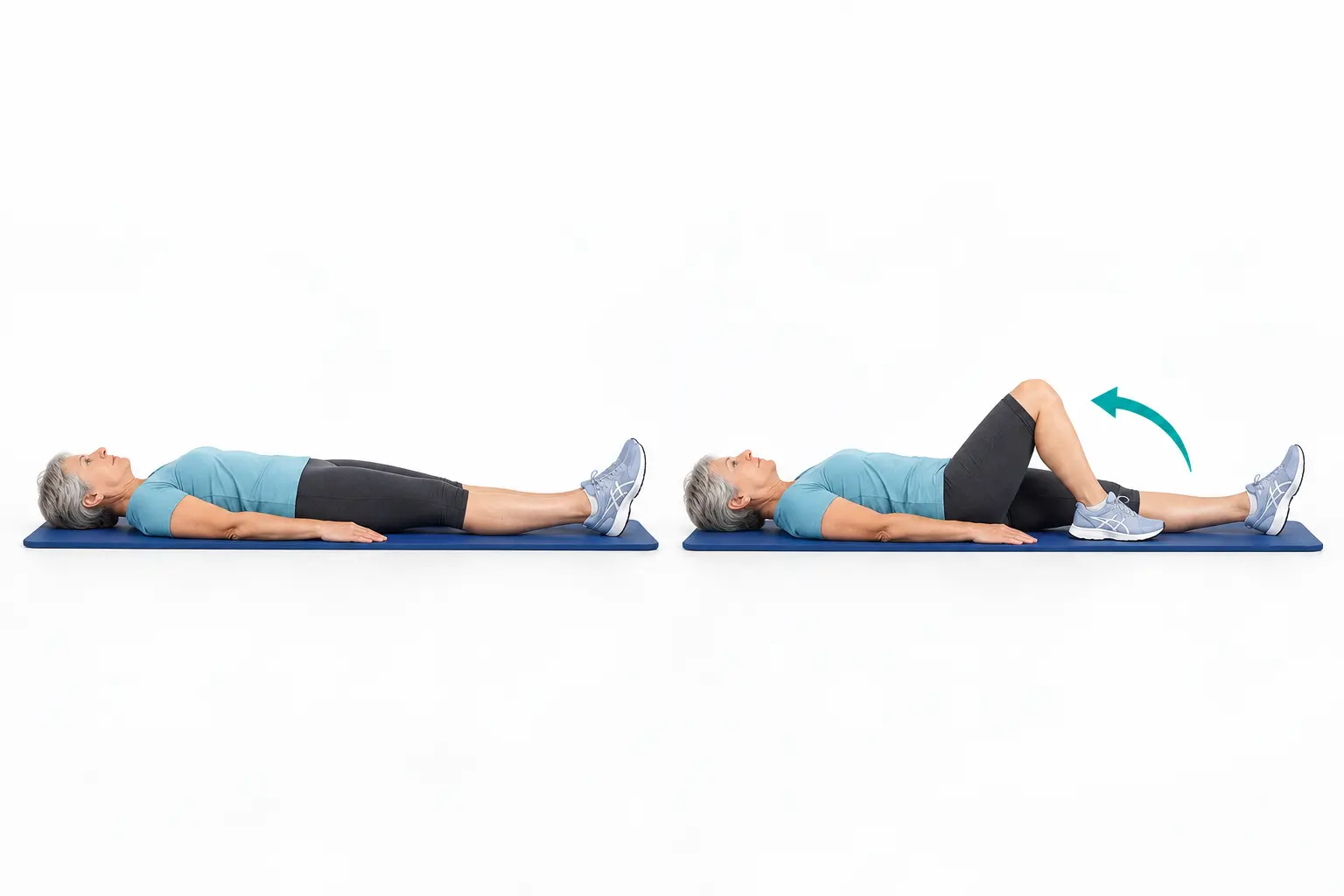
- Lie on your back on a bed or comfortable exercise mat with the leg relaxed and straight.
- Keeping your heel supported, slowly slide it towards your bottom and allow the knee to bend as far as feels comfortable.
- Slide the heel away again until the leg returns to the starting position.
This exercise is intended to practise comfortable bending and straightening when the knee feels stiff.
Exercise 2 · Quadriceps control
Seated knee extension
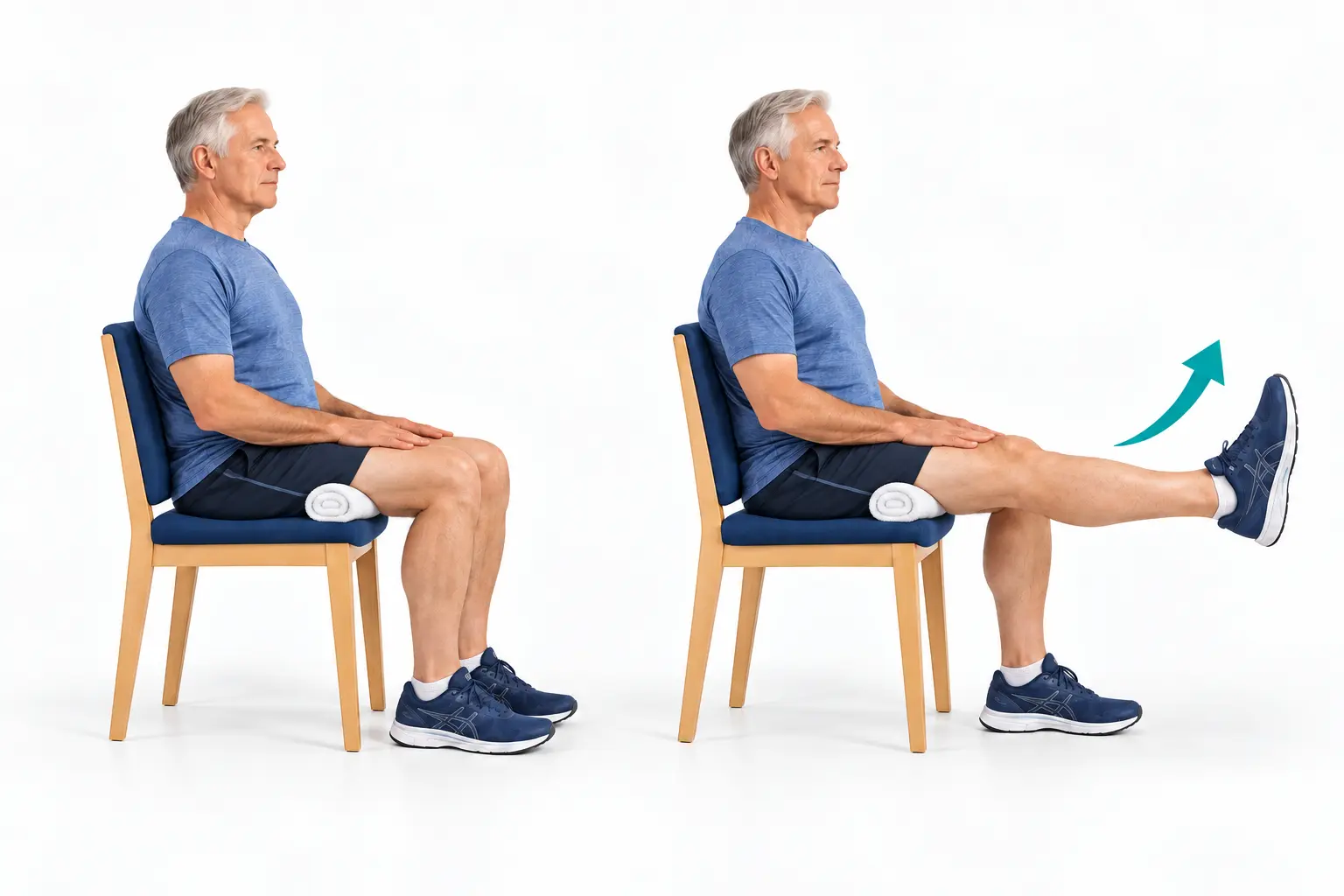
- Sit upright on a stable chair with both feet supported.
- Place a small rolled towel beneath the lower part of the thigh, close to the knee.
- Slowly straighten the working leg forwards and pause briefly in a comfortable position.
- Lower the foot back to the floor with control.
This movement works the quadriceps at the front of the thigh, which helps support the knee during walking, standing and stairs.
Exercise 3 · Everyday strength
Sit-to-stand without using your hands
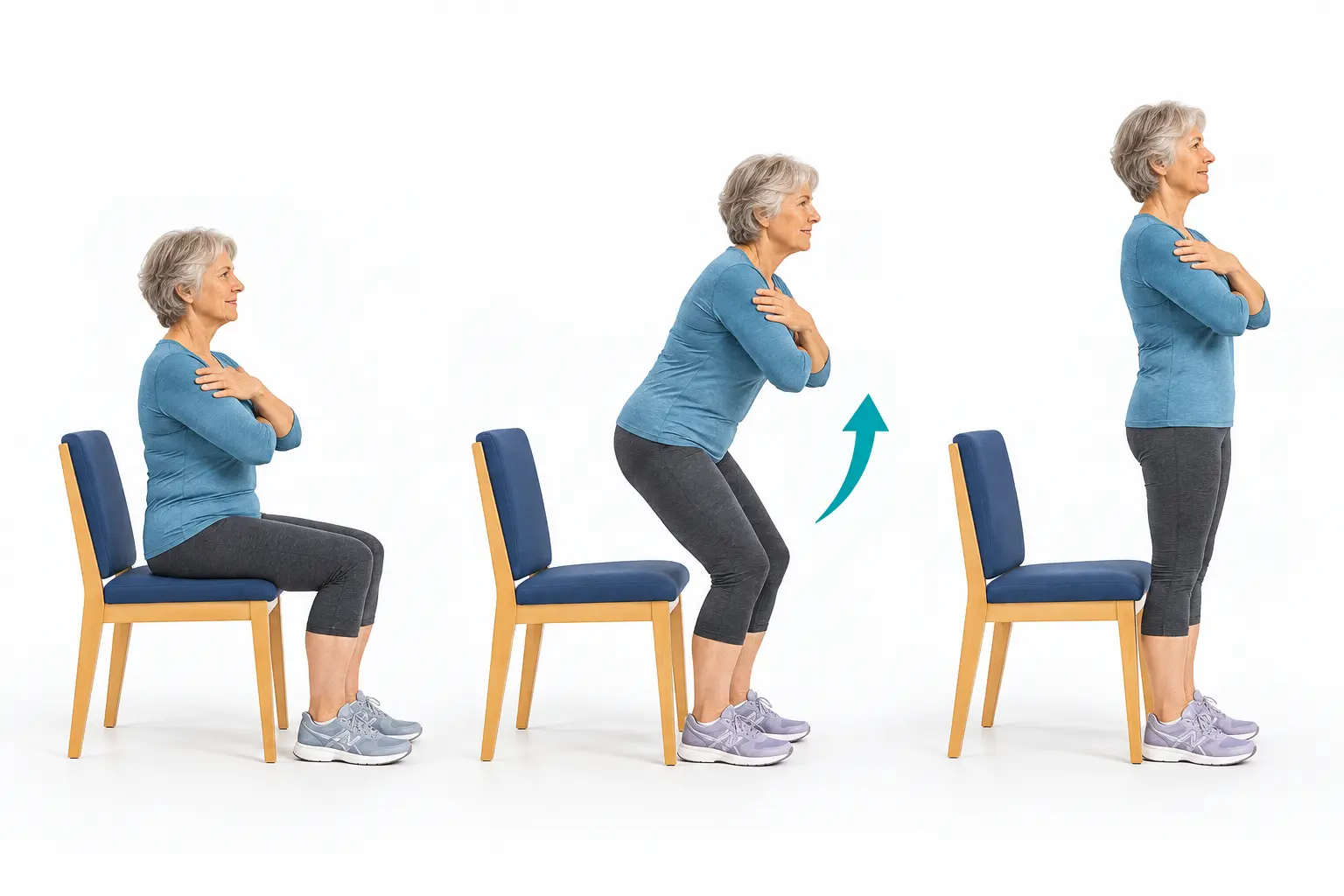
- Sit near the front of a stable chair. Place your feet and knees about hip-width apart.
- Cross your arms, lean your body forwards and push through your legs to stand. Keep the knees tracking over the feet rather than dropping inwards.
- Return to sitting slowly, reaching your bottom back towards the chair and controlling the movement throughout.
If this is too difficult or painful, begin from a higher, secure surface such as a taller chair or raised bed edge.
Common questions
Knee osteoarthritis exercise FAQs
Can exercise make knee osteoarthritis worse?+
A short-lived increase in discomfort can occur when exercise begins or progresses, but this does not automatically mean the joint is being damaged. Reduce the range, repetitions or frequency if symptoms become increasingly painful, more continuous or remain clearly worse afterwards.
Are these exercises suitable for everyone with knee osteoarthritis?+
No exercise sheet can account for every diagnosis, health condition or level of ability. These are general starting examples. Marked swelling, recent injury, locking, instability or difficulty bearing weight may require assessment before progressing exercises.
How often should I do these knee exercises?+
Complete 2 sets of 15 to 20 repetitions twice daily. Reduce or stop if your symptoms do not settle.
Evidence used
Sources and further reading
- NICE NG226: Osteoarthritis in over 16s - recommendations
- Exercise therapy for knee osteoarthritis: systematic review of reviews (2026)
Published and clinically reviewed 20 September 2026. This page will be reviewed when material guidance changes, or by September 2027.