
The starting point
Choose a manageable level.
Patellar tendinopathy often causes localised pain just below the kneecap during jumping, running or squatting. The tendon connects the kneecap to the shin. Assessment matters because kneecap joint pain, bursitis and an acute tendon injury can need different care. These options are for adults with an assessed tendon problem, not a recent tear or postoperative knee.
A trial involving 76 people with mainly longstanding patellar tendinopathy found better symptom and function scores after 24 weeks with progressive tendon loading than with the comparison eccentric programme. Most participants were young athletes. This supports staged rehabilitation, but does not establish one exercise or dose as best for everyone. Read the clinical trial.
Temporarily reduce the running, jumping or deep knee bends that repeatedly flare symptoms. Maintain tolerable activity and rebuild the tendon load gradually. Start with a manageable option below; you do not need to complete all three together. A wall hold does not reliably give immediate pain relief to everyone.
Before you start
Keep the response manageable over the following day.
Use a firm floor, a stable chair and a secure low step. Begin with a shallower bend or a few repetitions. The starting amounts are deliberately small and can be adjusted after assessment.
A mild, controlled ache may be acceptable, but sharp or escalating pain is a reason to stop. Reduce the depth, repetitions or load if symptoms remain clearly worse the next morning, walking becomes harder or swelling increases. Persistent deterioration needs review rather than repeatedly pushing through.
Seek urgent NHS 111 advice for a very painful or badly swollen knee, inability to bear weight, locking, or a hot red knee with fever or feeling unwell. A sudden pop with new inability to straighten the knee after an injury needs urgent assessment for a possible tendon rupture; do not test it repeatedly with squats.
Introduce a tolerable load · Exercise 1 of 3
Shallow wall hold
Load the thigh muscles while keeping the knee position still.
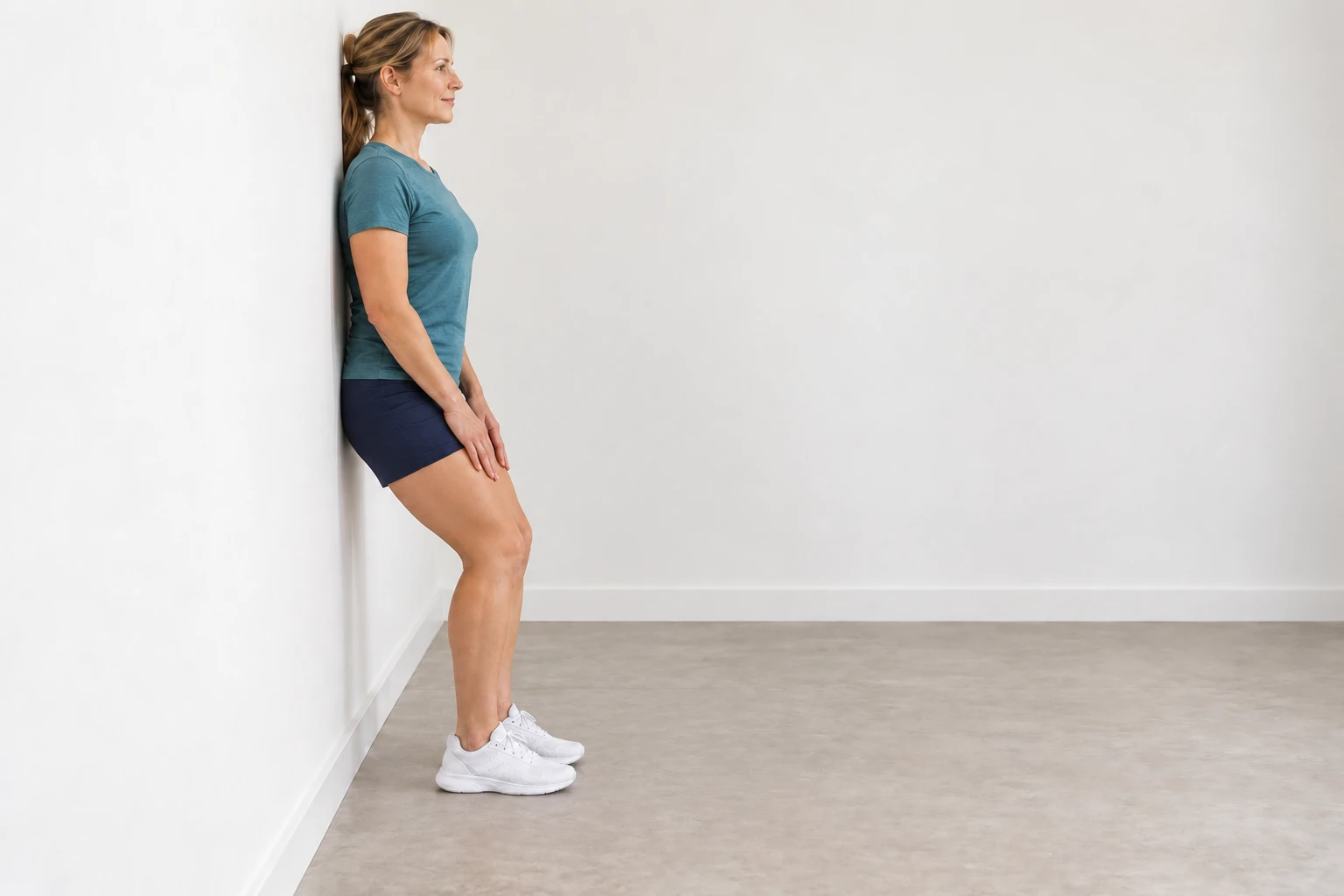
- Rest your back against a wall, with feet hip-width apart and a comfortable distance forwards.
- Slide down a little, sharing weight evenly. Keep both heels down and the knees aligned with the feet.
- Hold without straining or holding your breath, then rise slowly. You do not need a deep seated position.
Make it fit: Use a shallower bend or shorter hold. Rest about a minute between holds and stop if pain builds.
- Starting amount
- 1 set
- Repetitions / time
- 2–3 holds of 10–15 seconds
- Frequency
- Once daily if well tolerated
Build movement and strength · Exercise 2 of 3
Controlled squat to a chair
Practise controlled lowering and rising for everyday tasks.
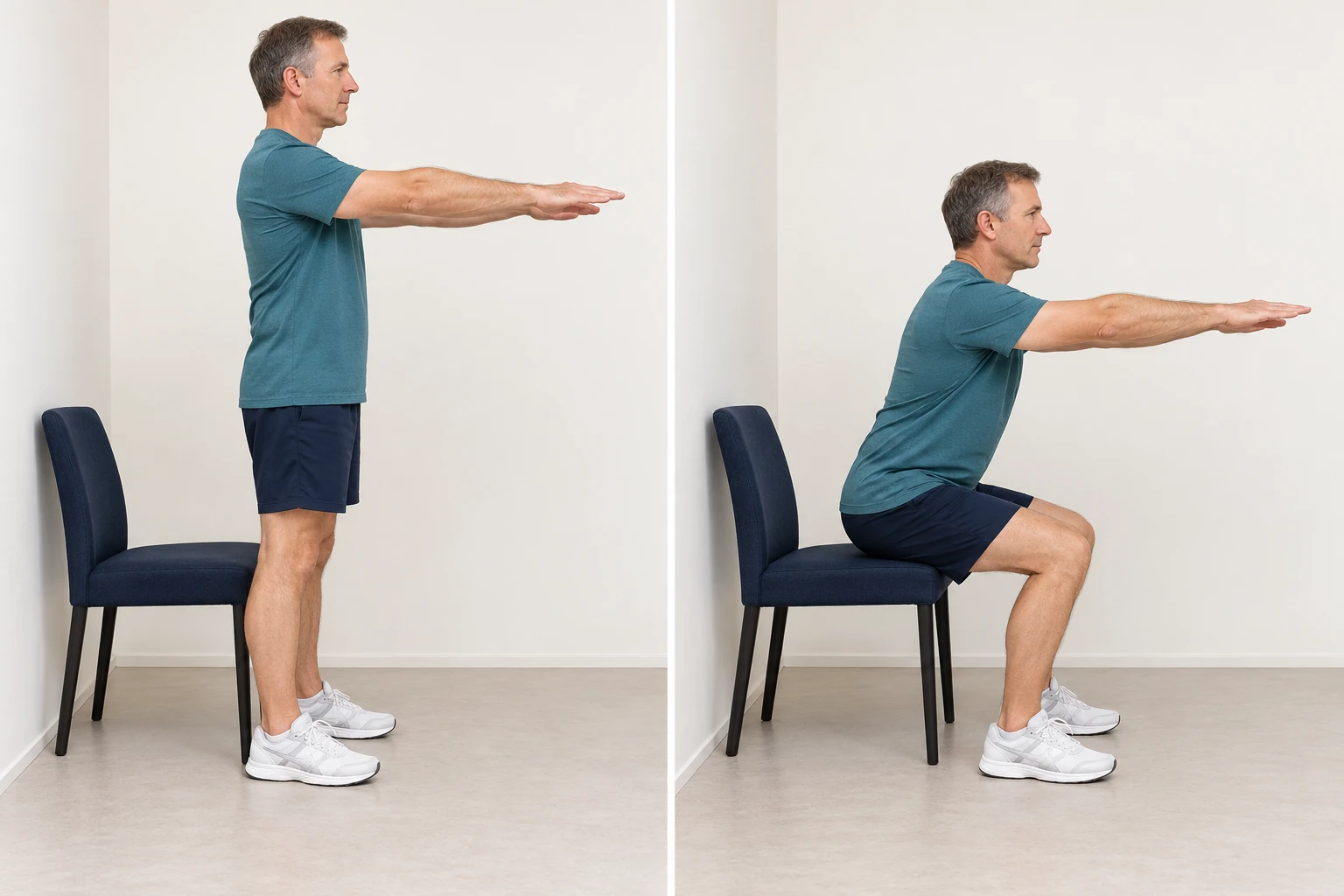
- Place a firm chair against a wall and stand just in front of it, feet hip-width apart.
- Bend the hips and knees slowly to touch or sit lightly on the seat. Keep the knees following the feet.
- Press through both feet to stand. Begin without weights and use your hands for support if needed.
Make it fit: Use a higher seat or a shallower squat. Build control before increasing depth or adding resistance.
- Starting amount
- 1 set
- Repetitions / time
- 5–8 slow repetitions
- Frequency
- 2–3 days weekly; rest a day between
Further strength option · Exercise 3 of 3
Supported low step-up
Introduce more load through one leg when the earlier exercises settle well.
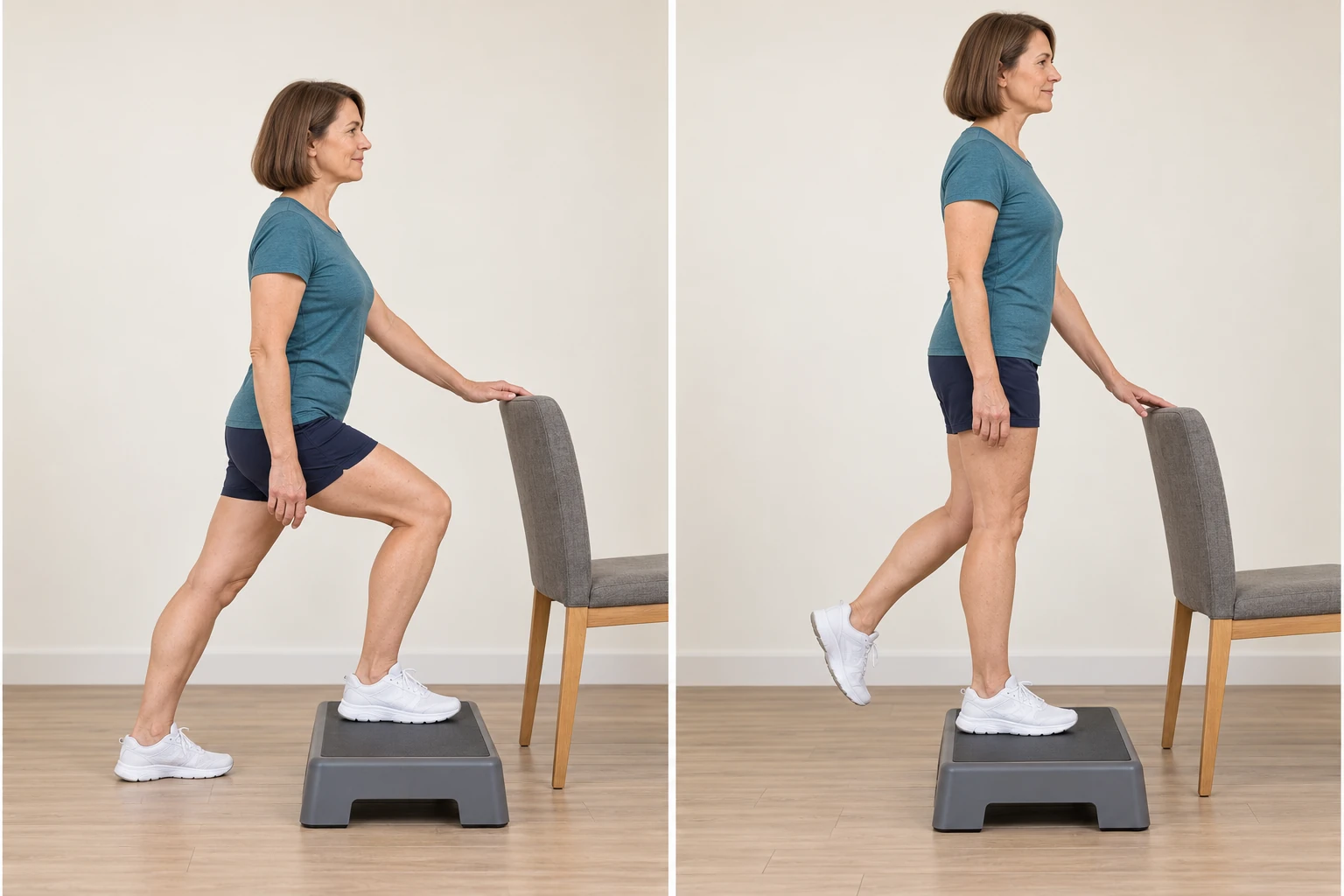
- Put the whole affected-side foot on a secure low step, around 10 cm high. Hold a fixed rail or stable chair.
- Push through that foot to rise, keeping the knee aligned with the toes. Use the trailing leg as little as needed.
- Return the trailing foot slowly to the floor. Keep the working foot on the step.
Make it fit: Use a lower step or stay with chair squats if you limp, lose balance or need to push strongly off the other foot.
- Starting amount
- 1 set
- Repetitions / time
- 4–6 controlled repetitions
- Frequency
- 2–3 days weekly; rest a day between
Progression
Build strength, then prepare for faster loading.
If several sessions settle well, add a few repetitions or a second set before increasing load. Resistance, depth and single-leg work can progress with guidance. Bodyweight exercises may eventually be too easy to develop the capacity your activities require.
For running and jumping sports, later rehabilitation also needs graded hopping, landing, faster loading and sport practice. Rebuild volume and intensity gradually, monitoring the next-day response. Improvement is often measured over months; completing these starters alone does not clear you for competition. Read about knee pain assessment and treatment in Hull.
Resolve MSK Clinic · Hull & East Riding
Build a programme around your everyday activities.
At 44 Bond Street, Hull, assessment considers your symptoms, movement, strength and the demands of work, home or sport. We can adjust exercise selection, check technique and plan progression around your goals.
At our Bond Street clinic, we assess the knee and relevant hip and ankle function, strength and activity demands. Ultrasound may help a specific tendon question when it could change management; a scan alone cannot determine the source of pain or readiness for sport.
See what an appointment involves on our private physiotherapy in Hull page, or find the clinic on Bond Street.
Sources and image credits
Where this advice comes from.
This guide draws on a patellar tendon loading trial and NHS patient advice on staged strengthening. Instructions are original and the demonstrations are newly AI-generated images, not patient photographs. The exact three-exercise combination has not been tested as one treatment programme.
Amounts are conservative starting examples. A rehabilitation plan may need different exercises, heavier resistance and further stages according to the assessment and your response.
- Breda et al. (2021): progressive tendon loading randomised trial
- Kingston and Richmond NHS: patellar tendinopathy and phased exercises
- Dorset NHS MSK: patellar tendinopathy rehabilitation
- NHS: knee pain and urgent warning signs
Sources checked 1 November 2026. General information, not an individual diagnosis or prescription. Review due November 2027, or sooner if guidance materially changes.