
The starting point
Choose a manageable level.
Wall press-ups, supported shoulder rotation, a chair rise with reaching and pendulums offer different ways to practise shoulder movement and strength. Choose the movements that suit your current ability; you do not have to do all four.
Exercise and education are important parts of managing rotator cuff-related shoulder pain. The 2025 clinical practice guideline supports active rehabilitation, including resistance and movement-control exercises. This does not mean these four exercises, or one fixed dose, are best for everyone. Read the clinical guideline.
This guide uses the movements in the supplied moderate-level shoulder sheet. It is not a programme for a recent rotator cuff repair, dislocation or a new injury with marked weakness. Follow your surgical or treating team's restrictions when applicable.
Before you start
Use the response to guide the amount.
Try one set of a few movements first. The amounts below are examples, not targets everyone must reach. For strengthening, begin on non-consecutive days. Your clinician's individual advice takes priority.
Mild, brief discomfort can occur. Reduce the range, weight or repetitions if symptoms build during exercise, remain clearly worse the next day or affect your usual activities. Stop and seek advice for sharp pain or continuing deterioration.
Get urgent advice from NHS 111 for sudden severe pain, an inability to move the arm, deformity, marked swelling, persistent loss of feeling, or shoulder pain with fever or feeling unwell. A new injury with substantial weakness needs assessment before strengthening.
Exercise 1 of 4
Wall press-up
Practise pushing through the arms with support from the wall.
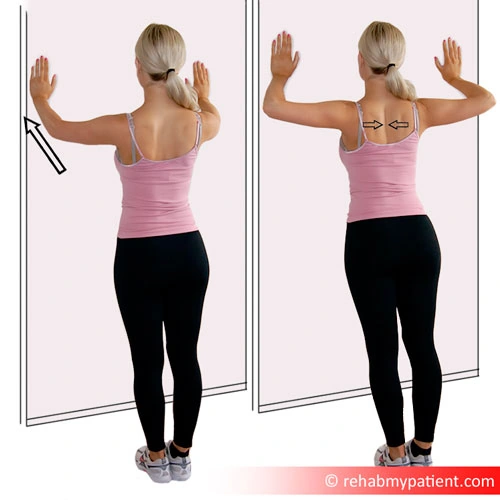
- Face a wall and place your palms around shoulder height, a comfortable distance apart.
- Keep your body in a straight line and bend your elbows to bring your chest towards the wall.
- Pause briefly, then press back slowly. Keep your feet steady and avoid forcing the shoulders.
Make it fit: Stand closer to make it easier. When comfortable, step slightly further back before increasing repetitions.
- Starting amount
- 1 set
- Repetitions / time
- 6–10
- Frequency
- 2–3 days a week
Exercise 2 of 4
Supported shoulder rotation
Introduce controlled rotation with the upper arm supported.
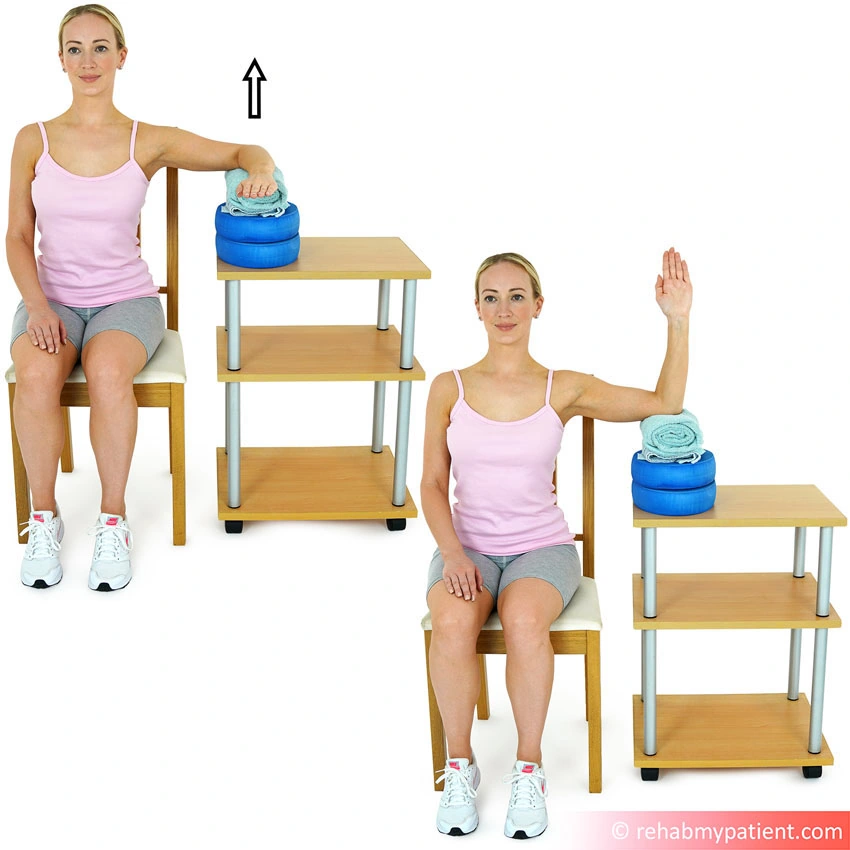
- Sit beside a table. Support your elbow on a cushion with the arm at a comfortable height and the elbow bent to a right angle.
- Keep the elbow supported. Slowly rotate the forearm upwards, then lower it forwards towards a comfortable horizontal position.
- Start without a weight. Add a small, light bottle only when the movement is manageable.
Make it fit: Lower the support or reduce the arc if needed. Do not force the hand as high as the illustration.
- Starting amount
- 1 set
- Repetitions / time
- 6–10
- Frequency
- 2–3 days a week
Exercise 3 of 4
Sit-to-stand with a comfortable reach
Combine an everyday movement with comfortable shoulder elevation.
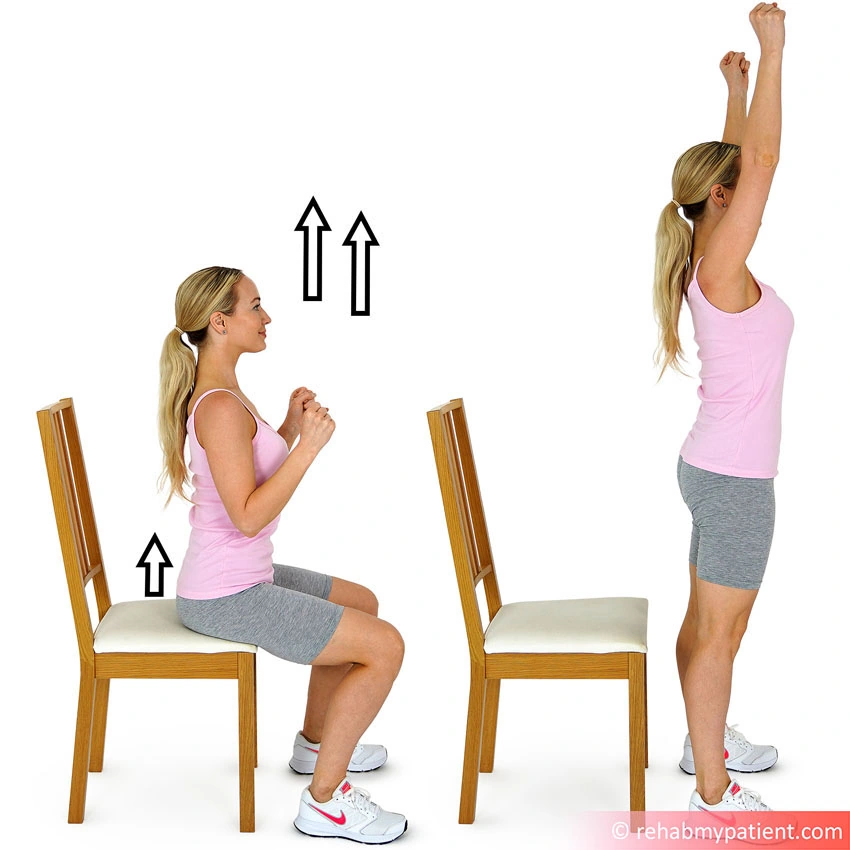
- Sit on a firm chair secured against a wall, feet supported and elbows bent.
- Stand up and raise your arms only as far as feels comfortable, as shown. You do not need to reach overhead.
- Lower your arms and sit down slowly. Practise the arm movement while seated if your balance or legs limit the chair rise.
Make it fit: Begin with a short reach and no weights. Only combine the movements if you can stand safely without using your hands.
- Starting amount
- 1 set
- Repetitions / time
- 5–8
- Frequency
- Once a day
Exercise 4 of 4
Gentle pendulum
Explore gentle movement when the shoulder feels stiff; this is not a strengthening exercise.
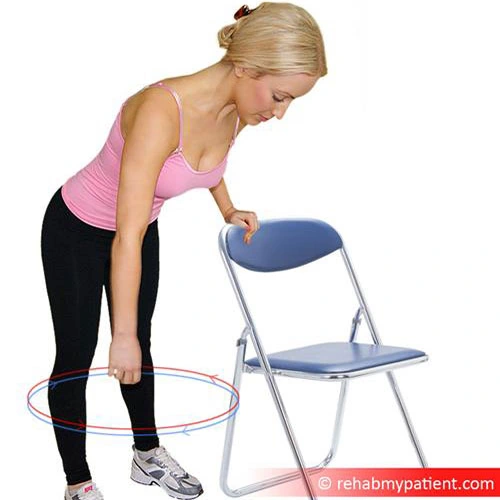
- Support yourself with one hand on a stable table or chair and lean forwards comfortably.
- Let the other arm hang relaxed. Gently shift your body to let it move in small circles.
- Try both directions without forcing the arm or making large swings.
Make it fit: Make smaller movements or stop if hanging the arm increases pain.
- Starting amount
- 1 set
- Repetitions / time
- 20–30 seconds
- Frequency
- Once or twice daily
Progression
Change one thing at a time.
When the same amount feels manageable over several sessions and symptoms settle afterwards, add a few repetitions, a second set or a small increase in resistance. Avoid increasing everything together. Reduce the amount again if the response is less settled.
Progress should also help a useful task: reaching a shelf, dressing, using tools or returning to sport. Repeated flare-ups or little progress are reasons to review the diagnosis and programme. Read about rotator cuff-related shoulder pain assessment and treatment in Hull.
Resolve MSK Clinic · Hull & East Riding
Build a programme around your everyday activities.
At 44 Bond Street, Hull, assessment considers your symptoms, movement, strength and the demands of work, home or sport. We can adjust exercise selection, check technique and plan progression around your goals.
See what an appointment involves on our private physiotherapy in Hull page, or find the clinic on Bond Street.
Sources and image credits
Where this advice comes from.
CHCP MSK Physiotherapy: Rotator cuff related shoulder pain — MODERATE, dated 18 July 2022. Exercise selection and original Rehab My Patient illustrations are taken from the supplied sheet; copyright markings remain visible.
The original sheet lists 12–20 repetitions, 2–3 times a day. The smaller starting amounts below are adaptations for general advice, not a replacement for an individual prescription. The chair-rise wording follows the standing reach shown in the illustration.
- Desmeules et al. (2025): Rotator cuff tendinopathy clinical practice guideline
- NHS: shoulder pain, self-care and warning signs
Evidence and source sheets checked 28 September 2026. General information, not an individual diagnosis or prescription. Review due September 2027, or sooner if guidance materially changes.