
The starting point
Choose a manageable level.
The five movements in this moderate-level sheet practise elbow and shoulder strength. They may support rehabilitation when those areas need work, but they do not form a complete tennis elbow programme.
The lateral elbow pain guideline recommends progressive resisted wrist-extensor exercise for subacute or persistent tennis elbow. Shoulder and shoulder-blade strengthening can be added when an assessment identifies a need. These broader arm exercises should complement, rather than replace, appropriate wrist and forearm loading. Read the clinical guideline.
Tennis elbow commonly hurts with gripping and lifting. Begin with light or no weights and avoid gripping harder than needed. Direct wrist-extensor exercises are not pictured in this supplied sheet; a clinician can help select and dose them. Reduce tasks that repeatedly aggravate symptoms while gradually rebuilding tolerance.
Before you start
Use the response to guide the amount.
Try one set of a few movements first. The amounts below are examples, not targets everyone must reach. For strengthening, begin on non-consecutive days. Your clinician's individual advice takes priority.
Mild, brief discomfort can occur. Reduce the range, weight or repetitions if symptoms build during exercise, remain clearly worse the next day or affect your usual activities. Stop and seek advice for sharp pain or continuing deterioration.
Seek urgent advice for a hot, swollen elbow with fever, severe pain or deformity after injury, an inability to move the arm, or new significant numbness or weakness. Persistent or worsening symptoms need assessment rather than repeatedly increasing the weights.
Exercise 1 of 5
Seated biceps curl
Build tolerance to bending the elbow while holding a light object.
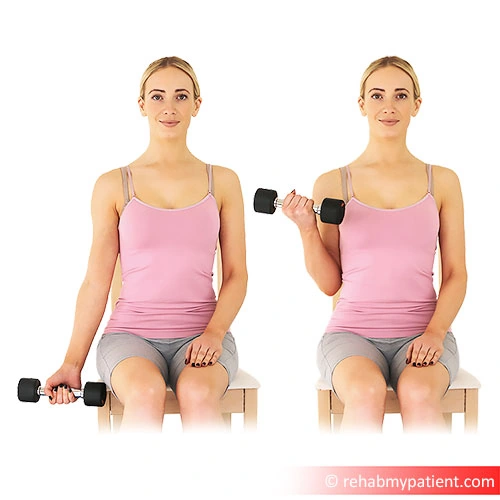
- Sit upright holding a light weight with the palm facing forwards or upwards.
- Keep the elbow beside your body and the wrist comfortably straight as you bend the elbow.
- Lower slowly without swinging the weight or squeezing it excessively.
Make it fit: Use a lighter object or practise without a weight if gripping provokes the elbow.
- Starting amount
- 1 set
- Repetitions / time
- 6–10
- Frequency
- 2–3 days a week
Exercise 2 of 5
Hammer curl
Practise elbow loading with a thumb-up grip.
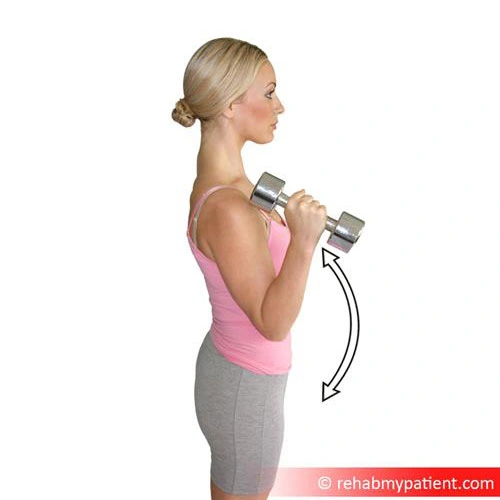
- Hold a light weight with the thumb pointing up, as if holding a hammer.
- Keep the elbow close to your side and bend it slowly without bending the wrist.
- Lower with control. Keep the shoulder relaxed and avoid swinging.
Make it fit: Choose the curl variation that is better tolerated; both are not essential in the same session.
- Starting amount
- 1 set
- Repetitions / time
- 6–10
- Frequency
- 2–3 days a week
Exercise 3 of 5
Sit-to-stand with a comfortable reach
Practise coordinated arm elevation during an everyday task.
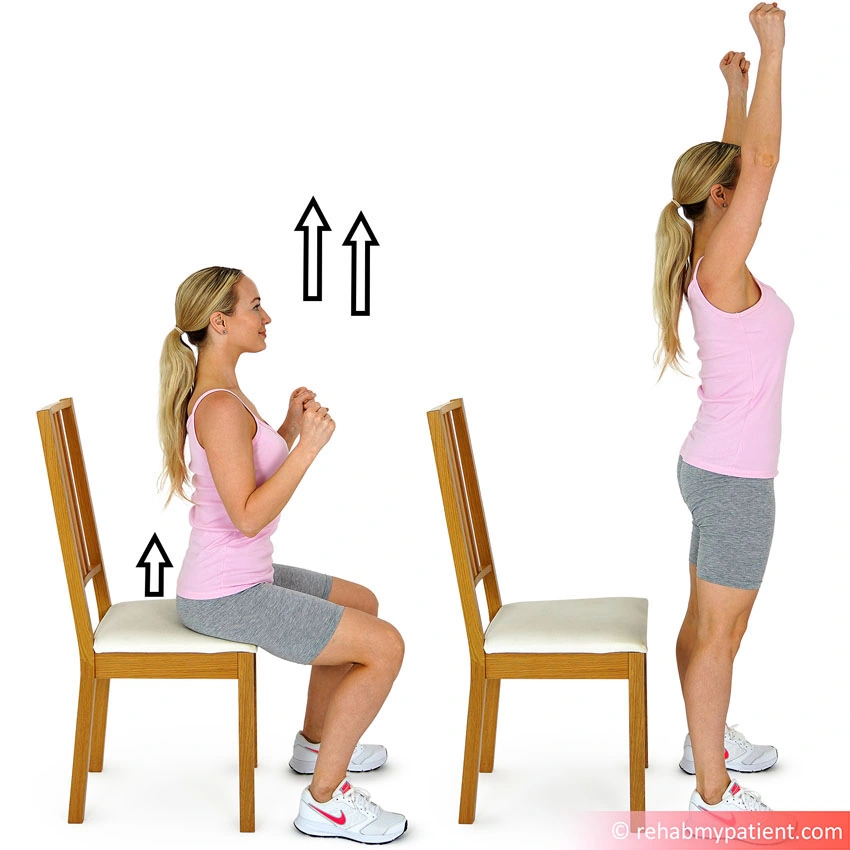
- Use a firm chair against a wall, with both feet supported and elbows bent.
- Stand and raise the arms into a comfortable reach, as shown. Keep the hands relaxed.
- Lower the arms and sit down slowly. Use seated arm raises instead if standing is difficult or unsteady.
Make it fit: Start below shoulder height if needed. This is an optional coordination exercise, not direct tendon strengthening.
- Starting amount
- 1 set
- Repetitions / time
- 5–8
- Frequency
- Once a day
Exercise 4 of 5
Alternating shoulder press
Build upper-arm and shoulder capacity when overhead tasks are relevant.
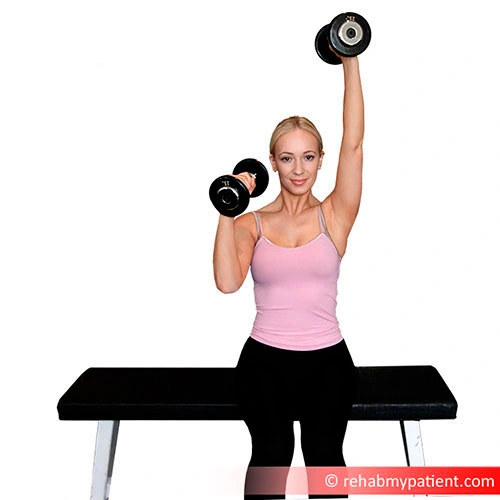
- Sit securely and hold light weights at a comfortable shoulder height, with the wrists straight.
- Press one arm upwards through a comfortable range, then lower slowly.
- Repeat on the other side without arching your back or forcing the arm overhead.
Make it fit: Begin without weights. Leave this exercise out if overhead movement or gripping increases symptoms.
- Starting amount
- 1 set
- Repetitions / time
- 6–10 per arm
- Frequency
- 2–3 days a week
Exercise 5 of 5
Thumb-up shoulder raise
Practise controlled lifting through the shoulder.
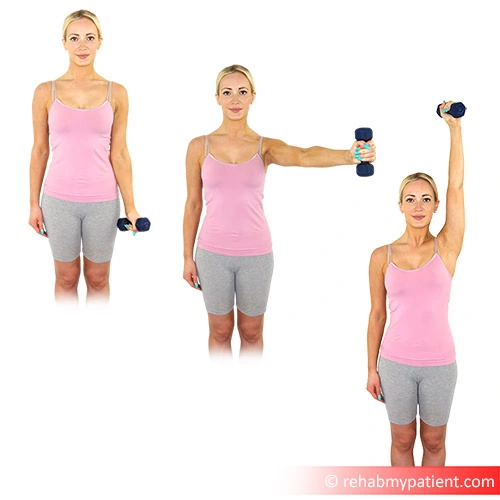
- Hold a light weight at your side with the thumb pointing upwards.
- Raise the arm slightly forwards of directly sideways, around 30–45 degrees forwards, towards shoulder height if comfortable.
- Lower slowly. Avoid shrugging, swinging or gripping harder as the arm rises.
Make it fit: Use no weight or stop below shoulder height to reduce the effort.
- Starting amount
- 1 set
- Repetitions / time
- 6–10
- Frequency
- 2–3 days a week
Progression
Change one thing at a time.
When the same amount feels manageable over several sessions and symptoms settle afterwards, add a few repetitions, a second set or a small increase in resistance. Avoid increasing everything together. Reduce the amount again if the response is less settled.
Progress should also help a useful task: reaching a shelf, dressing, using tools or returning to sport. Repeated flare-ups or little progress are reasons to review the diagnosis and programme. Read about tennis elbow assessment and treatment in Hull.
Resolve MSK Clinic · Hull & East Riding
Build a programme around your everyday activities.
At 44 Bond Street, Hull, assessment considers your symptoms, movement, strength and the demands of work, home or sport. We can adjust exercise selection, check technique and plan progression around your goals.
See what an appointment involves on our private physiotherapy in Hull page, or find the clinic on Bond Street.
Sources and image credits
Where this advice comes from.
CHCP MSK Physiotherapy: Tennis Elbow exercises — MODERATE, dated 11 August 2023. Exercise selection and original Rehab My Patient illustrations are taken from the supplied sheet; copyright markings remain visible.
The original sheet lists 3 sets of 8–12 repetitions on 4–6 days each week. The smaller starting amounts below are adaptations for general advice; the original volume may be too much for an irritable elbow. The chair-rise wording follows the standing reach shown in the illustration.
- Lucado et al. (2022): Lateral elbow pain and muscle function impairments guideline
- NHS: tennis elbow and activity advice
- NHS: elbow and arm pain, including warning signs
Evidence and source sheets checked 28 September 2026. General information, not an individual diagnosis or prescription. Review due September 2027, or sooner if guidance materially changes.