
When to seek urgent help
Sudden severe pain and swelling need prompt medical assessment.
If your wrist suddenly becomes severely painful and swollen, seek urgent advice through your GP or NHS 111. Heat, a change in skin colour, fever or feeling unwell add to the concern, but do not wait for a fever before seeking help. A joint infection needs urgent treatment. Do not wait for a routine ultrasound appointment. NHS urgent-care guidance.
Is wrist swelling a sign of a rheumatological condition?
It can be, but swelling alone cannot tell us the cause. Inflammatory arthritis can affect the wrist joint lining or the sheaths around its tendons. An injury or a local tendon problem can produce overlapping symptoms.
Rapid-onset pain and swelling can also occur with gout or calcium pyrophosphate crystal arthritis, sometimes called pseudogout. These can resemble infection. NICE advises considering all of these possibilities when assessing a painful, red, swollen joint, with immediate referral if infection is suspected. NICE guidance on an acutely swollen joint.
Where the swelling sits, how quickly it appeared, any injury, morning stiffness, other painful joints and your general health all help guide the assessment.
The ulnar side
What can swelling on the little-finger side mean?
The little-finger side is called the ulnar side of the wrist. One structure here is the extensor carpi ulnaris, or ECU tendon, which helps move and stabilise the wrist. Pain and swelling can involve this tendon and its sheath, or nearby joints.
Rheumatoid arthritis can cause ECU tendon-sheath inflammation. Local mechanical tendon problems can also cause ulnar wrist pain, so the location is a clue rather than a diagnosis. Research on rheumatoid wrist involvement; research on ECU tendon problems.
It would be misleading to say that rheumatological swelling is always, or usually, greatest here. An ultrasound study of 435 people with rheumatoid arthritis found prominent inflammation on the back of the wrist as well as involvement of tendon sheaths. Those findings describe a selected group with rheumatoid arthritis; they do not tell us the likelihood that any person with visible wrist swelling has the condition.
When do we consider inflammatory arthritis?
Persistent swelling, morning stiffness lasting longer than 30 minutes, difficulty making a fist and symptoms affecting other joints can raise suspicion. Both hands may be affected, although the pattern varies. These features need to be interpreted together. NHS information on rheumatoid arthritis symptoms.
Normal inflammatory markers or negative rheumatoid arthritis antibody tests do not completely exclude the condition. NICE recommends specialist assessment for persistent joint inflammation of an unexplained cause. Referral should be urgent in specified circumstances, including involvement of several joints or the small joints of the hands or feet. Tests should not delay referral. NICE referral recommendations.
An ultrasound appointment should therefore support the assessment, rather than become a step that holds up appropriate rheumatology care.
Different structures, different symptoms
What might be happening around the thumb?
Thumb symptoms may involve a different structure from swelling on the little-finger side. The site of pain and whether the thumb is stiff, painful to move or catching are useful distinctions.
De Quervain’s syndrome
This affects the tendons and their tunnel on the thumb side of the wrist. Thumb movement, lifting or gripping may be painful, sometimes with local swelling. It commonly affects adults aged 30–55, particularly women, and can occur when caring for a young baby. It is often diagnosed clinically without a scan. Newcastle Hospitals NHS guidance.
Thumb-base osteoarthritis
Pain at the base of the thumb can make opening jars, turning keys and pinching difficult. This form of arthritis usually appears after 45 and becomes more common with age. In advanced cases, the thumb base can look more prominent and the next joint may bend backwards more than usual. BSSH information on basal thumb arthritis.
BSSH reports X-ray changes in about 25% of women over 55, but many have no significant pain. That is a figure for changes visible on imaging, not the proportion of women who have painful thumb arthritis.
Trigger thumb
Catching, clicking or locking, often with tenderness on the palm side, may suggest trigger thumb. This involves the thumb’s bending tendon and its pulley. It usually affects adults over 40 and does not by itself establish rheumatoid arthritis. BSSH information on trigger thumb.
There is no single age range for wrist swelling
Age patterns differ by diagnosis. CPPD, for example, is more common after 60 and can cause sudden wrist inflammation. The ranges above describe common patterns; they are not cut-offs that confirm or exclude a condition. American College of Rheumatology information on CPPD.
Diagnostic musculoskeletal ultrasound
What can ultrasound show—and what are its limits?
Where clinically appropriate, ultrasound helps us examine the wrist joint lining, look for excess fluid and assess tendons and tendon sheaths. Doppler can show increased blood flow associated with inflammation. These findings help identify which tissues may be involved.
Ultrasound findings need to match the history and examination. Inflammation on a scan is not a diagnosis of rheumatoid arthritis, and a normal scan cannot reliably exclude early inflammatory disease. Results also depend on the equipment, scanning technique and interpretation.
A study comparing ultrasound and MRI in 70 people with early inflammatory arthritis or symptoms suspicious for it found that ultrasound missed some inflammation visible on MRI. It supports using ultrasound as one part of the diagnostic process, rather than a stand-alone test that provides every answer. Read the comparative ultrasound and MRI study.
Other investigations may sometimes be needed. For example, if crystal arthritis remains uncertain, joint-fluid testing may help identify the cause. When infection is a concern, a routine scan cannot replace urgent medical assessment. NICE guidance on further investigation.
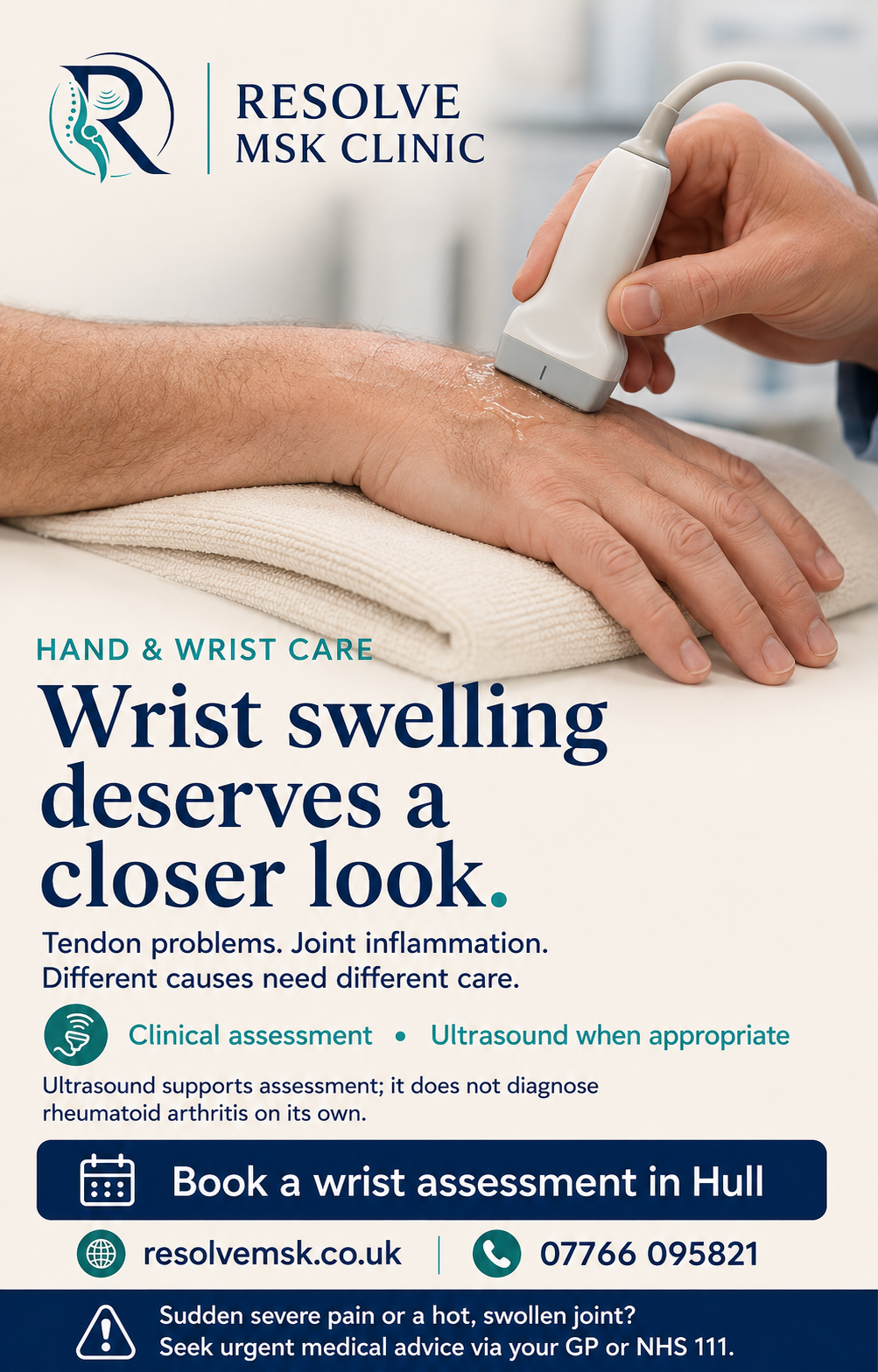
Wrist assessment in Hull
How we approach wrist and thumb problems at Resolve MSK
We start by listening to your symptoms, checking the wrist and hand, and understanding how the problem affects your work and everyday activities. Our musculoskeletal assessment in Hull helps establish a working diagnosis and identify whether further investigation or referral is needed.
Where appropriate, ultrasound adds information about the joint or tendons. We explain what the findings mean, their limitations and the next step. Depending on the diagnosis, this may include activity advice, an appropriate support, a tailored rehabilitation plan, further investigations or GP and rheumatology referral.
For conditions suitable for rehabilitation, private physiotherapy at Resolve can help you work towards comfortable movement and better function. Persistent inflammatory arthritis may need specialist disease-modifying treatment; exercise and local symptom relief do not replace that care. NICE guidance on rheumatoid arthritis management.
For sudden severe wrist pain and swelling, contact your GP urgently or NHS 111. Book a routine clinic assessment for ongoing symptoms once urgent causes have been addressed.
Evidence used
Sources and further reading
- NICE NG100: Rheumatoid arthritis in adults—referral, diagnosis and management (2018)
- NICE NG219: Gout—diagnosis and management (2022)
- NHS: Septic arthritis (reviewed March 2023)
- NHS: Rheumatoid arthritis—symptoms
- Podewski et al.: Wrist and tendon involvement in rheumatoid arthritis—observational ultrasound study (2022)
- Sato et al.: Stenosing tendovaginitis and tendinosis in constrained ECU tendinopathy (2023)
- Ohrndorf et al.: Ultrasound and MRI in early inflammatory arthritis—a comparative study (2019)
- Newcastle Hospitals NHS: De Quervain’s syndrome (updated November 2025)
- British Society for Surgery of the Hand: Basal thumb arthritis
- British Society for Surgery of the Hand: Trigger finger/thumb
- American College of Rheumatology: Calcium pyrophosphate deposition (updated February 2025)
Published 4 September 2026. Sources checked 4 September 2026. Review due September 2027, or sooner if relevant guidance changes. This article provides general information and does not replace an individual assessment.
By Kenneth Mgbakogu, Musculoskeletal Physiotherapist and Independent Prescriber at Resolve MSK Clinic.