
The starting point
Choose a manageable level.
This guide brings together four gentle exercises and four supported mobility options. Use it after an assessment has identified a frozen-shoulder pattern or your treating clinician has recommended these movements. The aim is to practise useful movement without repeatedly flaring pain.
NHS advice supports gentle shoulder movement and an individually selected exercise programme. Frozen shoulder commonly takes months, sometimes years, to improve. Exercise intensity should reflect your current pain, stiffness and response; no six-week programme can promise a cure. Read the NHS frozen shoulder advice.
Weeks 1–3 and weeks 4–6 are suggested periods within this programme, not the biological stages of frozen shoulder. The second set is an option when you are ready, not an automatic change on day 22. You may need to remain with the gentler stage longer, use fewer exercises or have a different plan after assessment.
Read about frozen shoulder assessment and treatment in Hull.
- Practise within a manageable range; the illustration shows the movement, not a position you must reach.
- Keep breathing normally. Avoid shrugging, twisting or using force to gain extra range.
- Gentle everyday use can continue alongside the programme. Break up tasks that repeatedly worsen pain.
- Review the plan if you are losing movement or function, or if symptoms are not settling with appropriate adjustments.
Before you start
Begin gently and check the response later that day and the next morning.
Use stable furniture and a clear floor. Start with one or two suitable exercises and the lower amounts shown. A light pull or mild, brief discomfort can be acceptable; sharp pain or a strong lingering flare is a reason to reduce or stop the movement. Your clinician's instructions take priority, especially after surgery, a fracture or dislocation.
Symptoms should settle back towards your usual level. If pain becomes more continuous, sleep is clearly worse or the shoulder remains more irritable the next day, reduce the range, effort, repetitions or frequency. Stop the particular exercise if it repeatedly aggravates symptoms and arrange a review. Do not push harder simply because movement is restricted.
Seek urgent GP or NHS 111 advice for sudden severe shoulder pain, inability to move the arm, deformity, marked swelling, persistent numbness or a hot shoulder with fever or feeling unwell. A new injury with major weakness needs assessment before exercises. Call 999 for shoulder discomfort with chest pain, breathlessness, sweating or feeling faint, or sudden arm weakness with stroke-like symptoms.
Your suggested programme
Weeks 1–3: a gentle start
Explore comfortable movement and low-effort muscle activation. The first two exercises use support and relaxation; the wall presses are static and should be light. You do not need to perform all four at every session.
- Begin at the lower starting amounts and add a little only after several manageable sessions.
- For a very painful shoulder, prioritise the comfortable supported movements and discuss whether the wall presses are appropriate.
- A harder push or larger circle is not a better exercise if it leaves you more sore afterwards.
Weeks 1–3 · Exercise 1 of 8
Relaxed shoulder pendulum
Explore gentle movement with the arm relaxed.
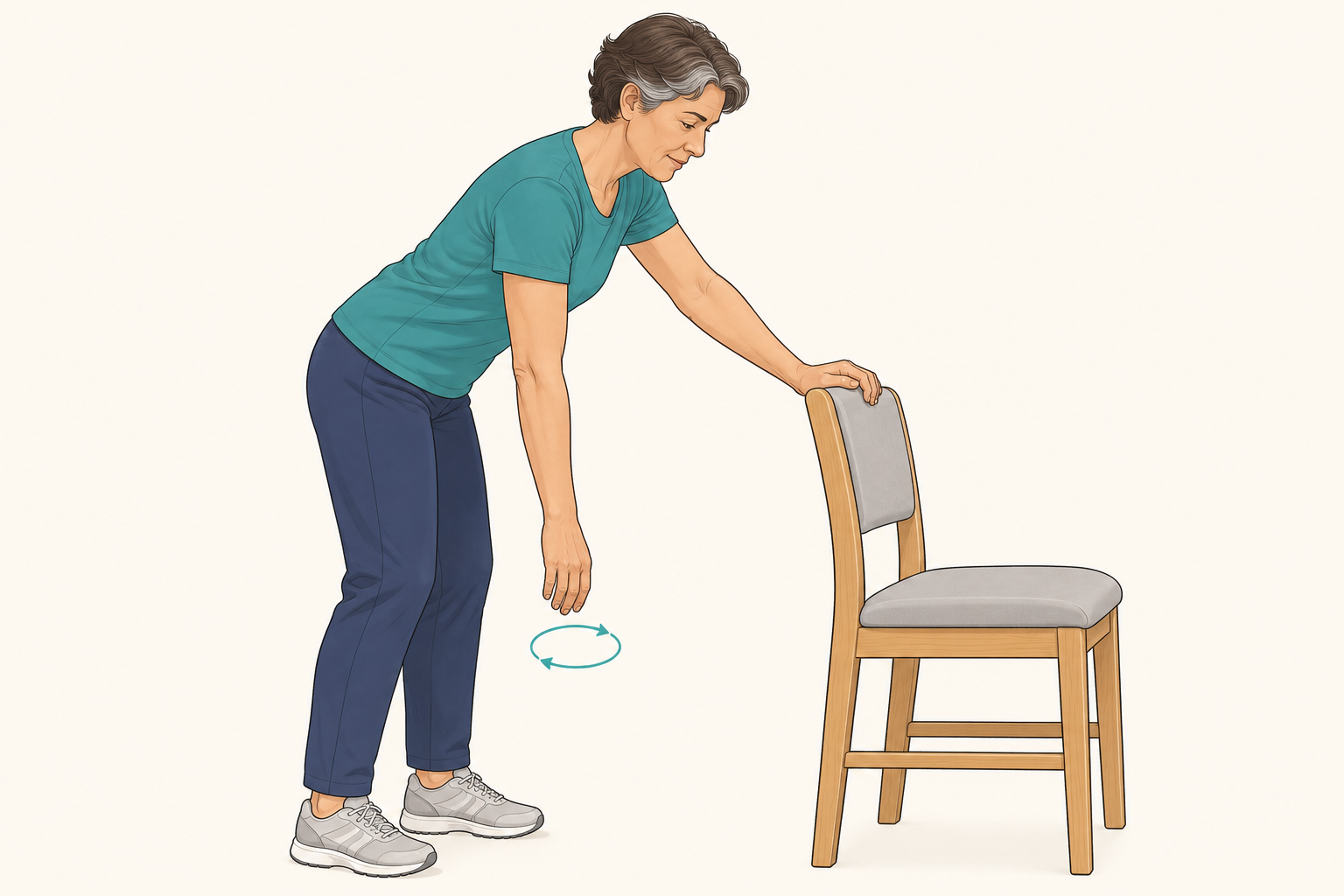
- Lean forwards, supporting yourself with the other hand on stable furniture.
- Let the affected arm hang loosely.
- Shift your body gently to make small circles in both directions.
Make it fit: Keep the circles small. If leaning is difficult, ask your clinician for a supported alternative.
- Starting amount
- One brief round
- Repetitions / time
- Start with 5–8 circles; build towards 15 total
- Frequency
- 1 short session initially; up to 2–3 daily if settled
Weeks 1–3 · Exercise 2 of 8
Seated table slide
Practise supported forward shoulder movement.
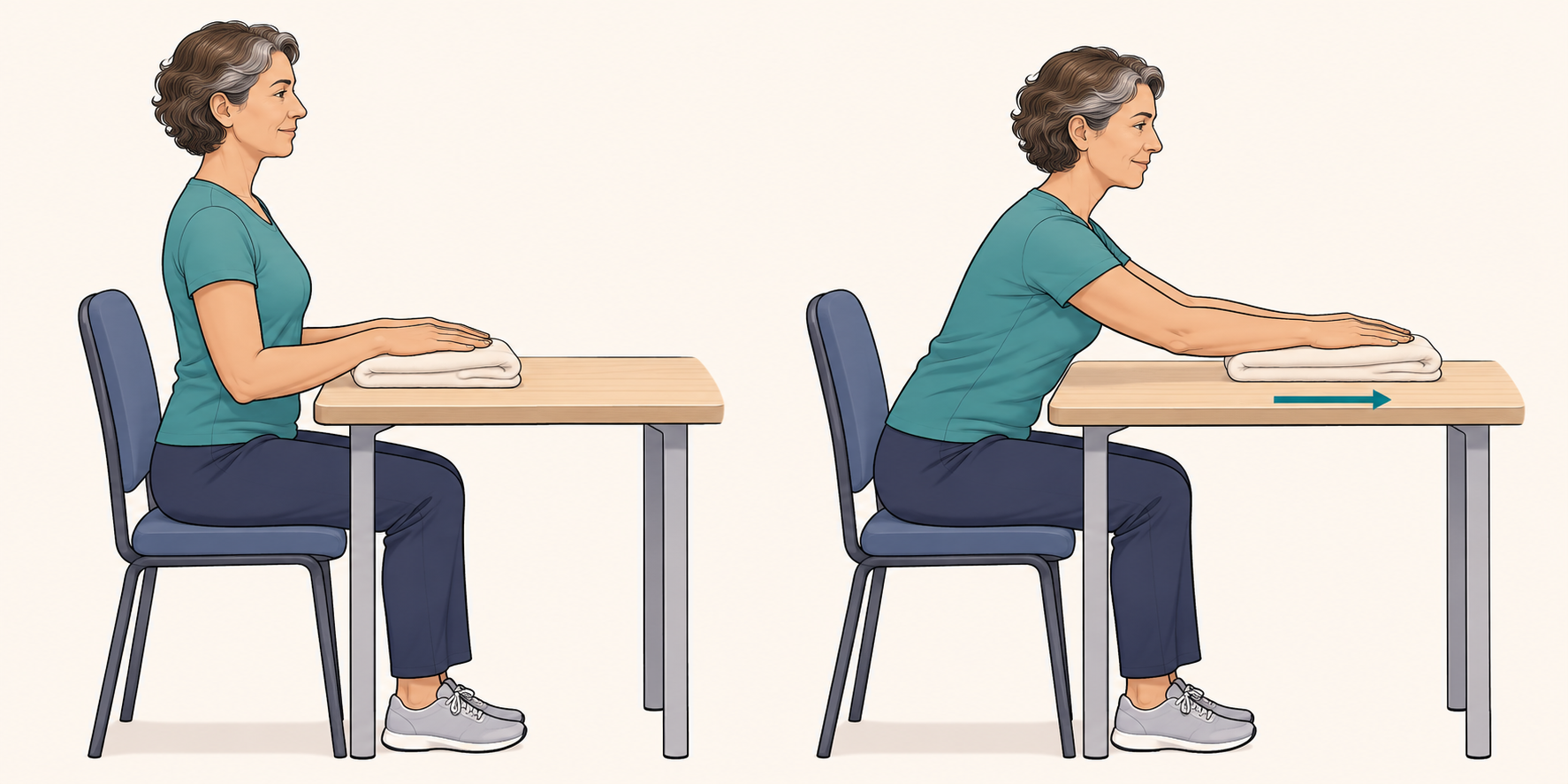
- Sit facing a table with your hands or forearms on a cloth.
- Slide forwards while gently leaning from the hips.
- Stop at a comfortable reach, then return slowly.
Make it fit: Keep the forearms supported. A shorter slide is useful; you do not need to match the picture.
- Starting amount
- 1 set
- Repetitions / time
- Start with 5–6; build towards 12
- Frequency
- 1 short session initially; up to 2–3 daily if settled
Weeks 1–3 · Exercise 3 of 8
Gentle forward wall press
Activate the shoulder without moving the joint.
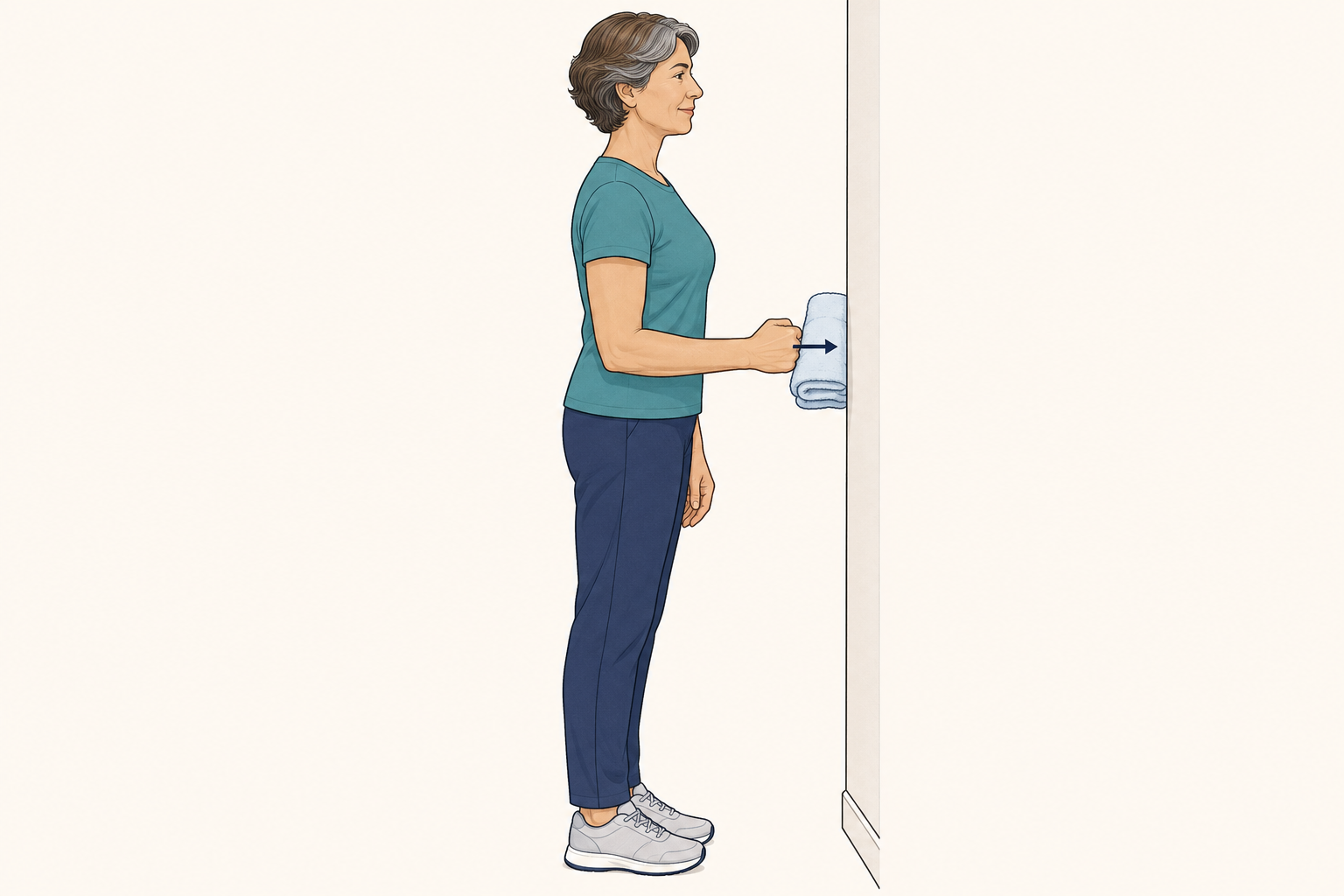
- Face a wall with the elbow bent and close to your side.
- Rest your fist against a folded towel on the wall.
- Press lightly forwards for about 3 seconds, then relax without moving the arm.
Make it fit: Reduce the force if uncomfortable. Do not hold your breath or push with your body weight.
- Starting amount
- 1 set; low effort
- Repetitions / time
- Start with 4–6; build towards 8–12
- Frequency
- 1 short session initially; up to 2–3 daily if settled
Weeks 1–3 · Exercise 4 of 8
Gentle outward wall press
Practise a low-effort static outward press.
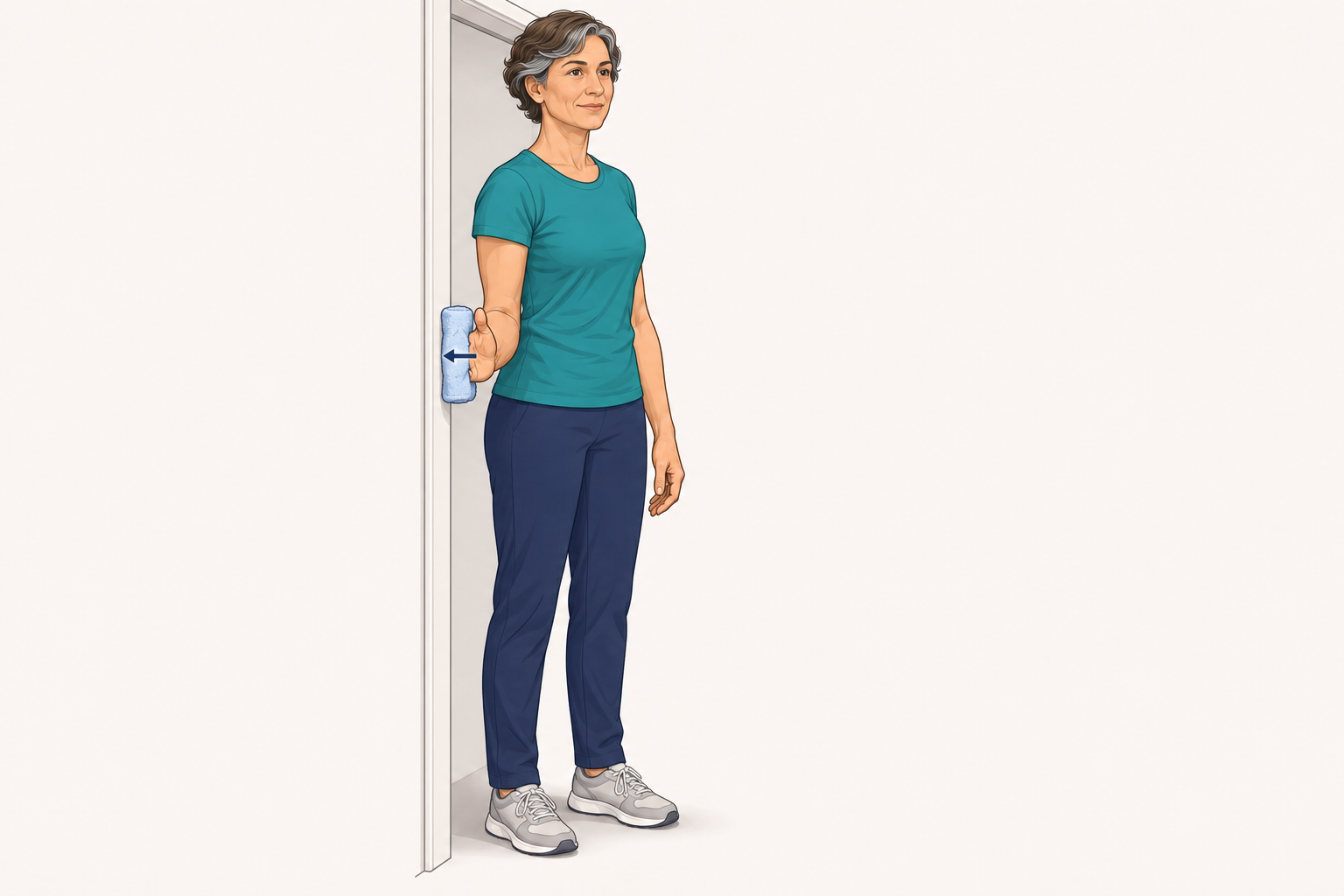
- Stand with the affected side beside a wall or door frame.
- Keep the elbow at your side, bent to a right angle.
- Press the outside of the hand gently outwards for about 3 seconds, then relax.
Make it fit: Keep the shoulder down and elbow still. Use less pressure or omit the exercise if it aggravates pain.
- Starting amount
- 1 set; low effort
- Repetitions / time
- Start with 4–6; build towards 8–12
- Frequency
- 1 short session initially; up to 2–3 daily if settled
Your suggested programme
Weeks 4–6: supported mobility, if ready
Consider these options after about three weeks of the gentler programme, provided the response is settled. Use the less painful arm to assist the affected side. You can keep a helpful easy exercise while adding one new movement at a time.
- The first-stage exercises feel manageable and do not produce a lingering flare or clear next-day deterioration.
- Sleep and everyday use are not steadily worsening, and there is no new injury, major weakness or urgent warning sign.
- Begin with a small range and one short set. Stay in stage one longer or seek review if these conditions are not met.
- The behind-the-back movement is optional and can be especially provocative. Leave it out if uncomfortable or if your clinician advises against it.
Weeks 4–6, if ready · Exercise 5 of 8
Assisted arm lift while lying down
Explore supported shoulder elevation.
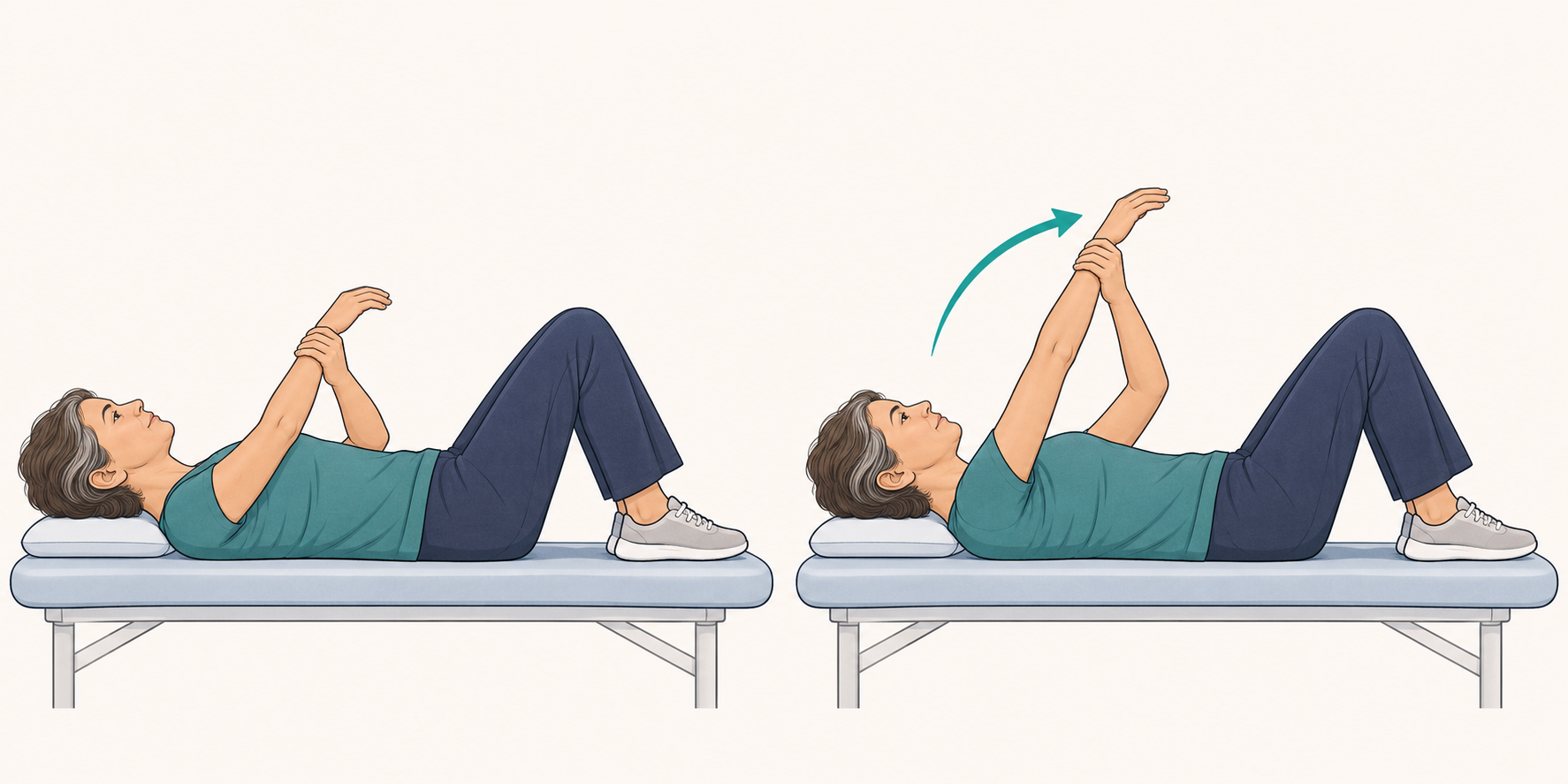
- Lie comfortably on your back and support the affected wrist with your other hand.
- Guide the relaxed arm upwards only as far as comfortable.
- Lower slowly while maintaining support.
Make it fit: Keep the back relaxed. Full overhead reach is not required, and forcing towards the headboard is unnecessary.
- Starting amount
- Start with 1 set; up to 2–3 if appropriate
- Repetitions / time
- Start with 5–8; build towards 15
- Frequency
- Once daily if settled
Weeks 4–6, if ready · Exercise 6 of 8
Assisted outward lift with a stick
Practise assisted movement outwards and forwards.
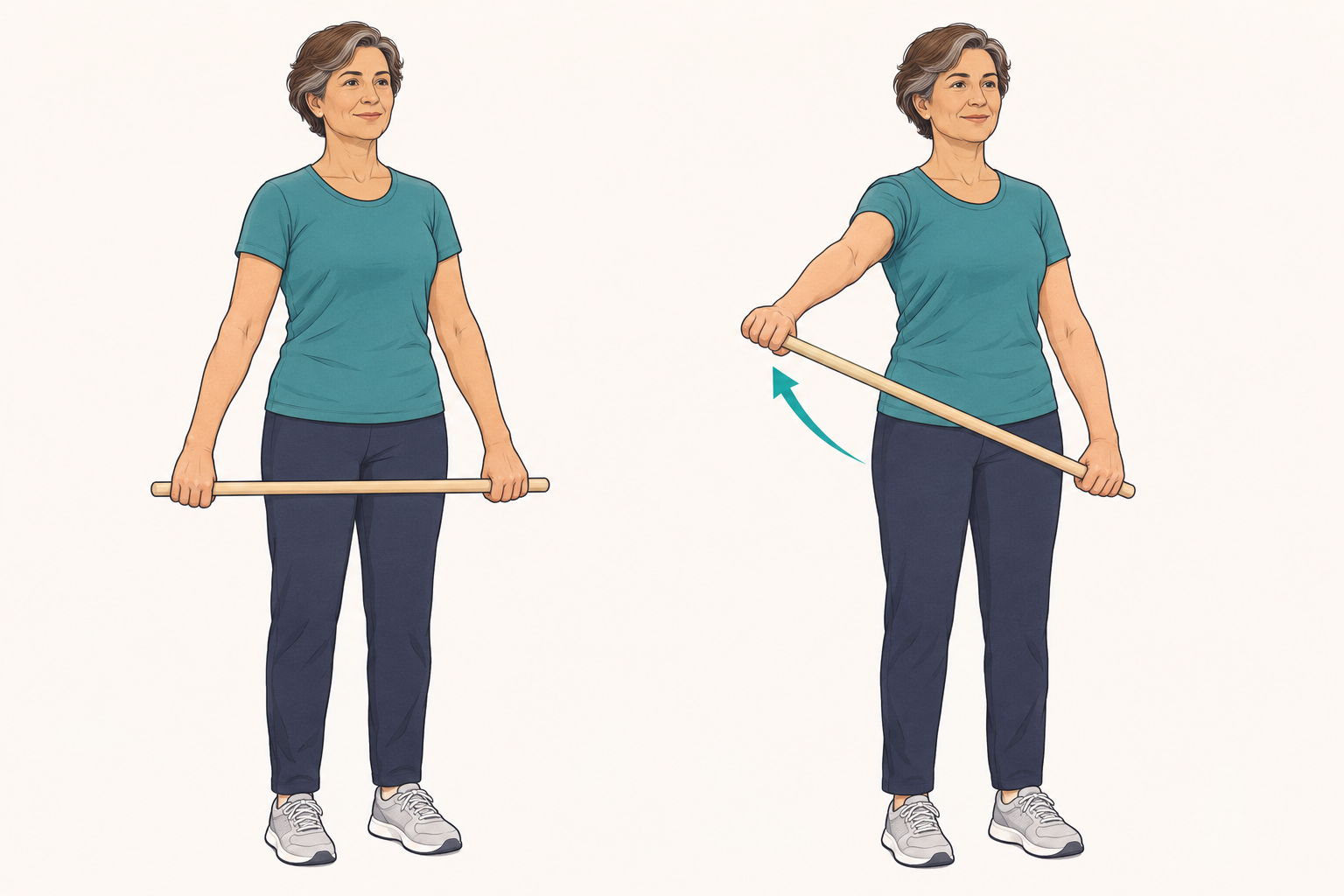
- Hold a light stick with both hands.
- Use the less painful arm to guide the affected arm outwards and slightly forwards.
- Keep the shoulder relaxed; return before you need to shrug or lean.
Make it fit: A small lift below shoulder height is enough initially. Do not use a heavy pole or force the affected arm upwards.
- Starting amount
- Start with 1 set; up to 2–3 if appropriate
- Repetitions / time
- Start with 5–6; build towards 12
- Frequency
- Once daily if settled
Weeks 4–6, if ready · Exercise 7 of 8
Assisted rotation with a stick
Explore gentle outward shoulder rotation.
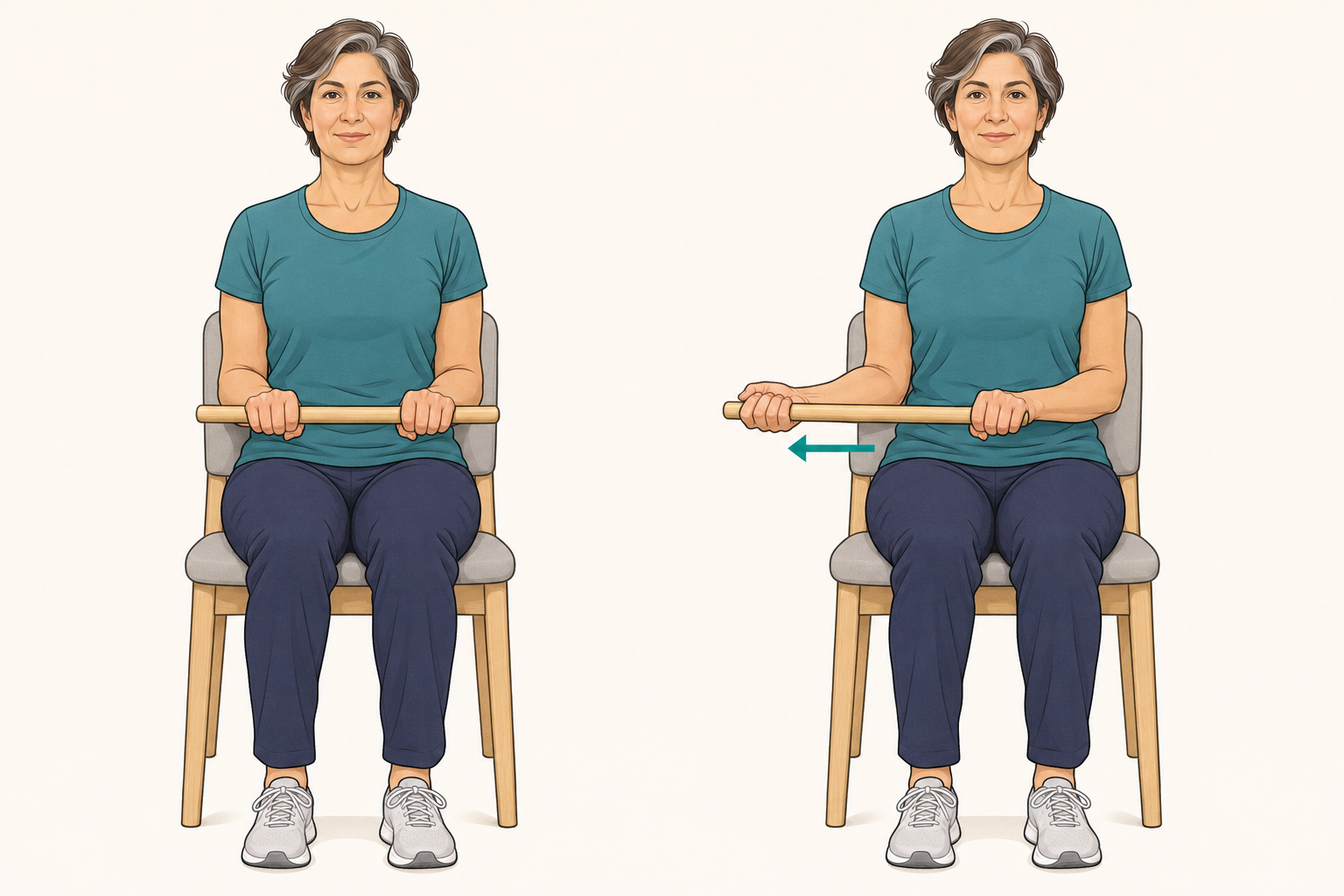
- Sit upright, holding a stick with both elbows bent and tucked in.
- Use the other hand to guide the affected forearm gently outwards.
- Keep the elbow close and trunk still, then return.
Make it fit: Stop before a strong stretch. Make the movement smaller if the shoulder wants to shrug or the body starts to twist.
- Starting amount
- Start with 1 set; up to 2–3 if appropriate
- Repetitions / time
- Start with 5–6; build towards 12
- Frequency
- Once daily if settled
Weeks 4–6, optional · Exercise 8 of 8
Gentle assisted reach behind the back
Explore a small supported behind-the-back reach.
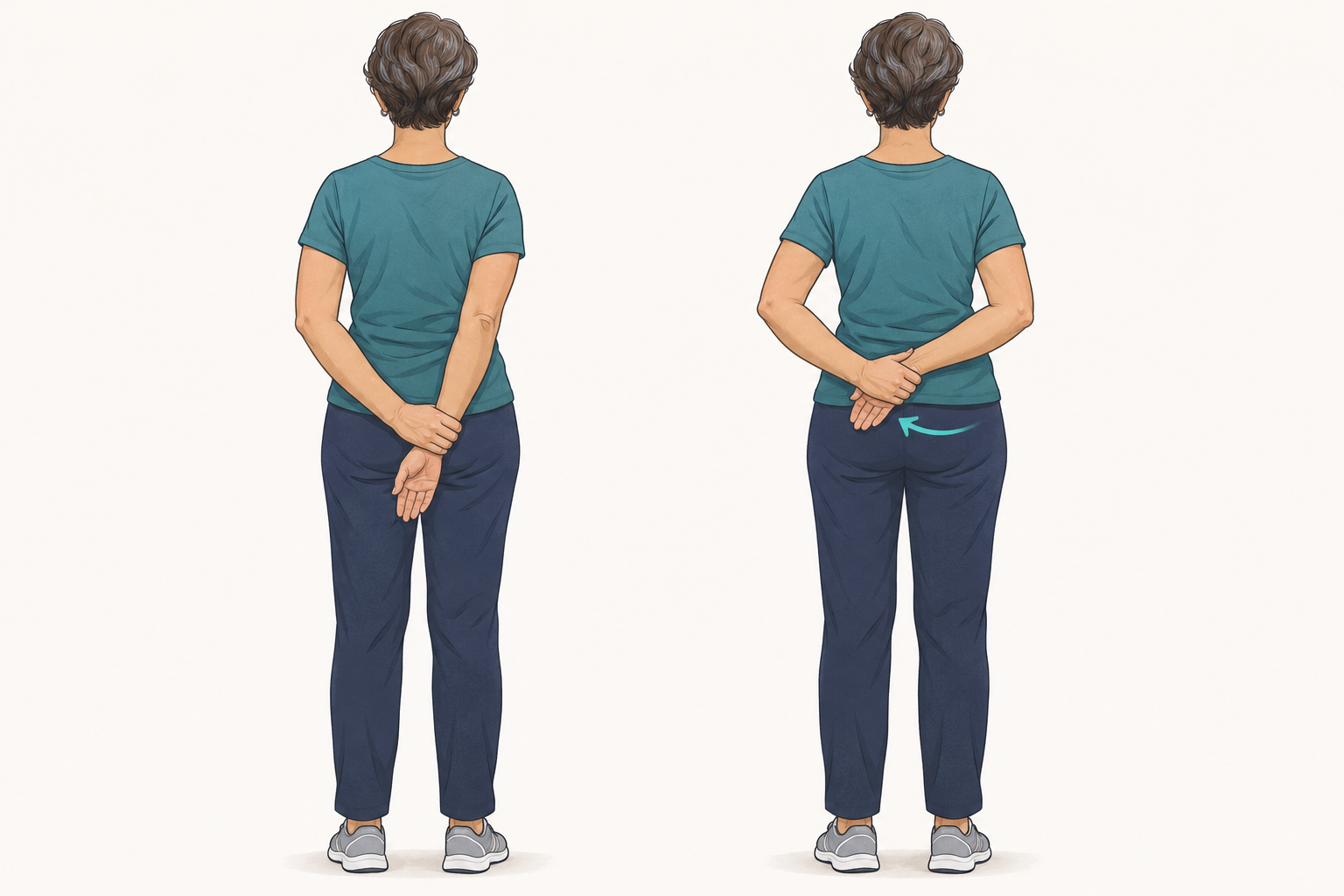
- Bring the affected hand towards your lower back.
- Use the other hand to support the wrist and guide a small comfortable movement.
- Release slowly; keep the shoulder relaxed.
Make it fit: Do not pull high between the shoulder blades. Skip this movement if it causes sharp pain, stronger night pain or a lasting flare.
- Starting amount
- 1 short set initially; do not force
- Repetitions / time
- Start with 3–5; up to 12 only if comfortable
- Frequency
- Once daily only if tolerated
Progression
After six weeks, review function rather than simply adding more exercises.
Progress one feature at a time: a few repetitions, a slightly larger comfortable range or another set. You do not need to reach the upper amounts or complete all eight exercises. If a new exercise is less comfortable, return to the previous manageable level and review the response before trying again.
Look for useful improvements in sleep, washing, dressing, reaching or using the arm at work. Persistent loss of movement, repeated flares or little functional progress should prompt a review; some shoulders need different rehabilitation or a discussion about other treatment choices. Read about frozen shoulder assessment and treatment in Hull.
Resolve MSK Clinic · Hull & East Riding
Build a programme around your everyday activities.
At 44 Bond Street, Hull, assessment considers your symptoms, movement, strength and the demands of work, home or sport. We can adjust exercise selection, check technique and plan progression around your goals.
We can review the programme if symptoms are limiting sleep or everyday function, check technique and discuss whether further investigation or another treatment option has a useful role.
See what an appointment involves on our private physiotherapy in Hull page, or find the clinic on Bond Street.
Sources and image credits
Where this advice comes from.
Exercise selection is informed by CHCP MSK Physiotherapy's Frozen Shoulder EASY and Frozen Shoulder Moderate sheets, both dated 19 July 2022. Instructions have been rewritten for this page and all eight illustrations were newly created for Resolve MSK Clinic. The source sheets' photographs and Rehab My Patient images have not been reproduced. The two three-week blocks are Resolve's suggested organisation, not a recovery timetable stated in the CHCP sheets.
The CHCP easy sheet uses short sessions two to three times a day. Its moderate sheet suggests daily practice with two to three sets. This page provides lower starting examples and makes any increase dependent on symptom response and individual advice.
- CHCP MSK Physiotherapy: Frozen Shoulder EASY (19 July 2022)
- CHCP MSK Physiotherapy: Frozen Shoulder Moderate (19 July 2022)
- NHS: Frozen shoulder
- Lee et al. (2025): Diagnosis and non-surgical treatment of primary frozen shoulder
- NHS: Shoulder pain and urgent warning signs
Sources checked 2 November 2026. General information, not an individual diagnosis or prescription. Review due November 2027, or sooner if guidance materially changes.