
The starting point
Choose a manageable level.
A tight, aching or stiff neck can involve muscles, joints and sensitivity to movement. Symptoms alone cannot identify one tissue as the cause. This guide offers options for uncomplicated neck pain; persistent arm pain, numbness or weakness needs assessment rather than assuming the problem is only muscular.
NHS advice supports keeping the neck moving and gradually building exercise within your tolerance. Comfortable mobility and selected shoulder-girdle strengthening can form part of rehabilitation. These six movements are options to choose from, not a proven best routine for every cause of neck pain. Read the NHS exercise guidance.
The first three movements adapt the early programme supplied; the final three adapt its advanced programme. The fourth exercise is another gentle movement option, not a requirement to reach full range. Add weighted work only when everyday movement is manageable. Recent surgery, a significant injury or a known unstable neck condition requires your treating team's advice first.
- Change position regularly during desk work and break up long periods of sitting; you do not need to hold one rigid posture all day.
- Keep up comfortable walking and usual activity where possible. Temporarily reduce tasks that repeatedly provoke symptoms.
- Do not drive or cycle if restricted neck movement prevents safe observation of traffic.
Before you start
Start small and move slowly.
Select one or two comfortable movements first. The amounts below are conservative starting examples, not a prescription to complete all six. Begin mobility once daily and, if helpful, spread short sessions through the day. Leave a rest day between weighted sessions. Your clinician's individual plan takes priority.
A gentle stretch or brief mild ache may be acceptable. Reduce the range, repetitions or load if symptoms build, disturb sleep or remain worse the next morning. Stop if movement causes new arm symptoms, dizziness or an unusual headache, and seek advice. A low pain score by itself does not prove an exercise is safe.
Seek urgent medical assessment for worsening arm or leg weakness, clumsy hands, new walking or balance difficulty, or new bladder or bowel changes. Neck pain after significant trauma, or severe headache with fever or feeling very unwell, also needs urgent assessment. Call 999 for sudden weakness with facial droop or speech difficulty. Arrange a review if pain persists or keeps worsening.
Early movement · Exercise 1 of 6
Gentle chin tuck
Practise a small, controlled neck movement without forcing a stretch.
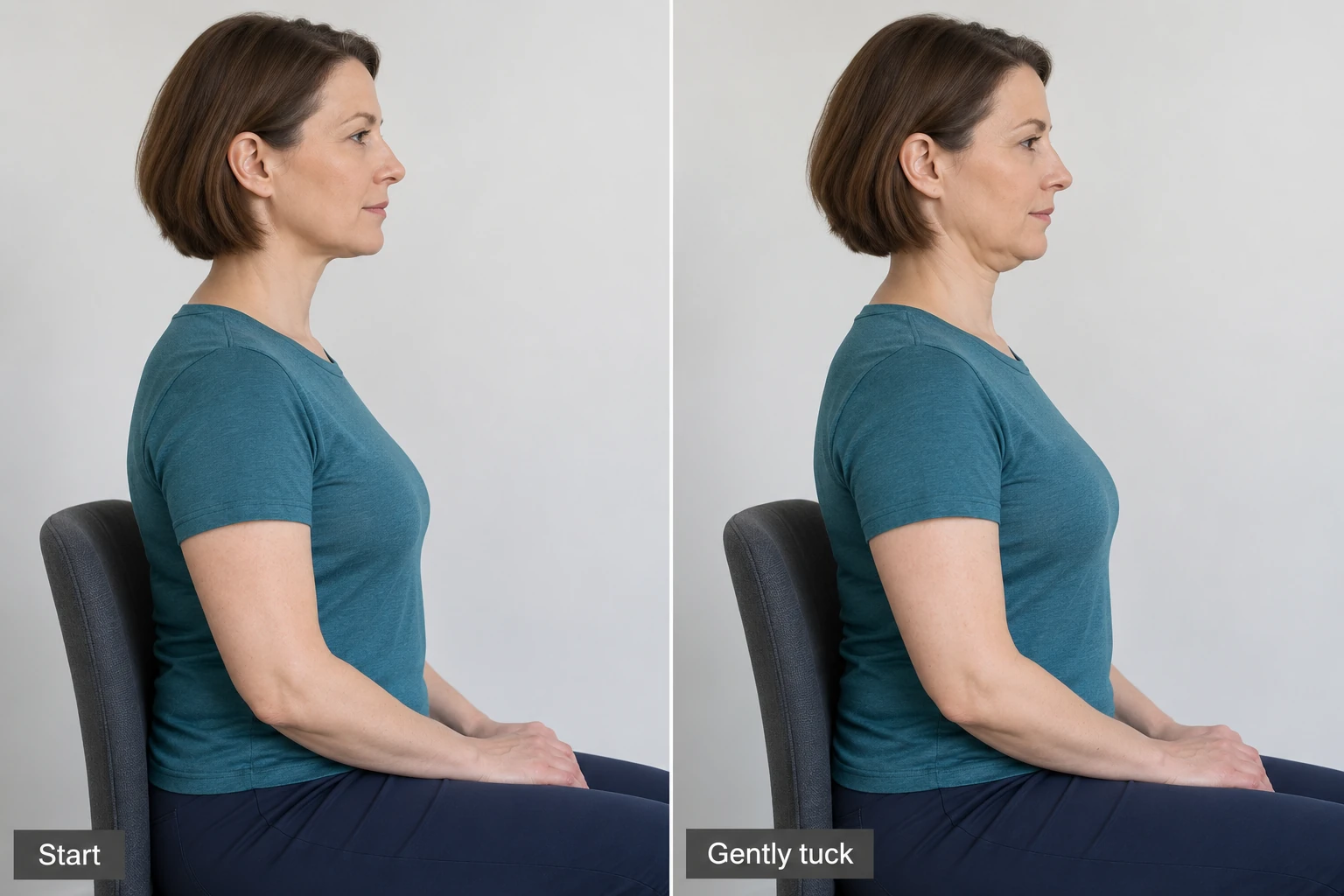
- Sit comfortably with your shoulders relaxed and eyes looking ahead.
- Draw your chin gently backwards as if making a small double chin. Keep your gaze level rather than tipping your head down.
- Hold lightly for up to 5 seconds, breathe normally, then relax. Do not push the head backwards with your hand.
Make it fit: Use a smaller movement and shorter hold if the neck feels sensitive.
- Starting amount
- 1 set
- Repetitions / time
- 3–5, holding up to 5 seconds
- Frequency
- Once daily to start
Early movement · Exercise 2 of 6
Slow neck rotation
Practise looking to either side through a comfortable range.
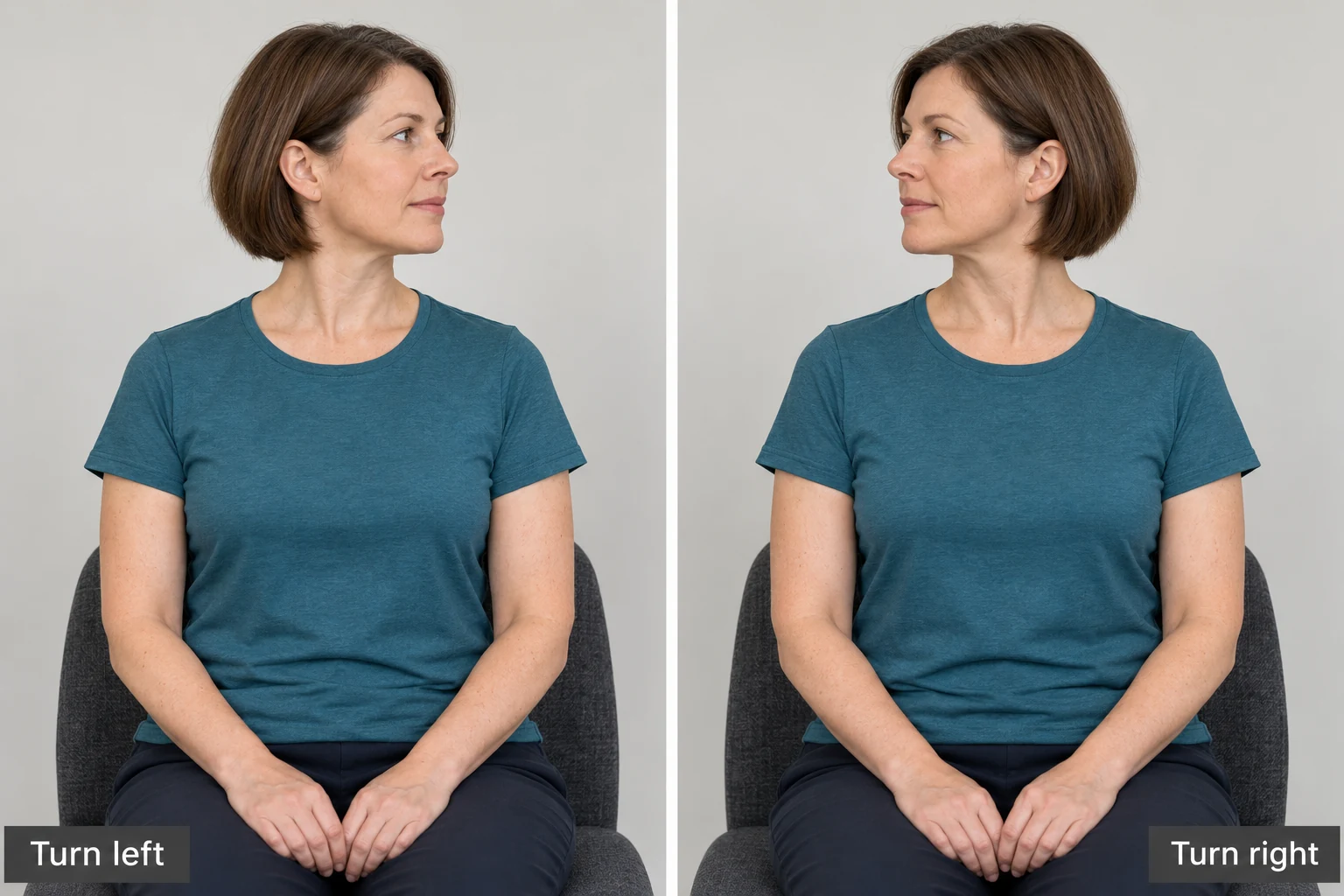
- Sit supported with your head level and shoulders facing forwards.
- Slowly turn to look over one shoulder as far as feels comfortable. Keep your body still without tensing it.
- Return to the centre, then repeat to the other side. Avoid jerking, bouncing or trying to increase the speed.
Make it fit: Turn less far on a sore side. The range does not need to be equal at first.
- Starting amount
- 1 set
- Repetitions / time
- 3–5 each way
- Frequency
- Once daily to start
Early movement · Exercise 3 of 6
Gentle neck side bend
Explore side-to-side movement when the neck and upper shoulder feel tight.
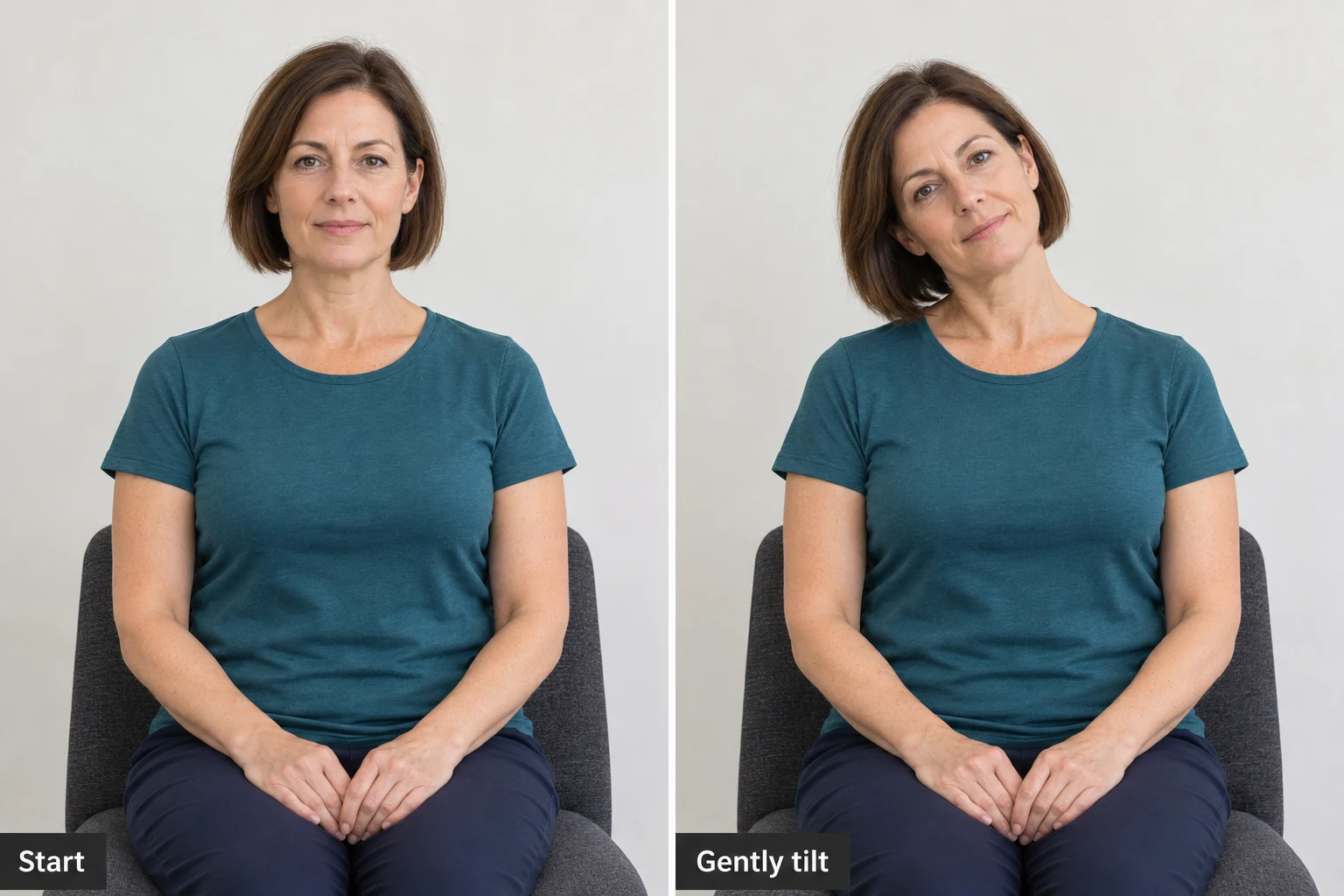
- Sit with both shoulders relaxed and your nose facing forwards.
- Tilt one ear gently towards the shoulder on that side without lifting the shoulder or turning the head.
- Pause for 2–5 seconds, return to centre and try the other side. Keep your hands down; do not pull on your head.
Make it fit: A small tilt is enough. Stop before a sharp stretch or pain spreading into the arm.
- Starting amount
- 1 set
- Repetitions / time
- 3 each side
- Frequency
- Once daily to start
Further movement option · Exercise 4 of 6
Comfortable looking down and up
Practise neck movement forwards and backwards without chasing full range.
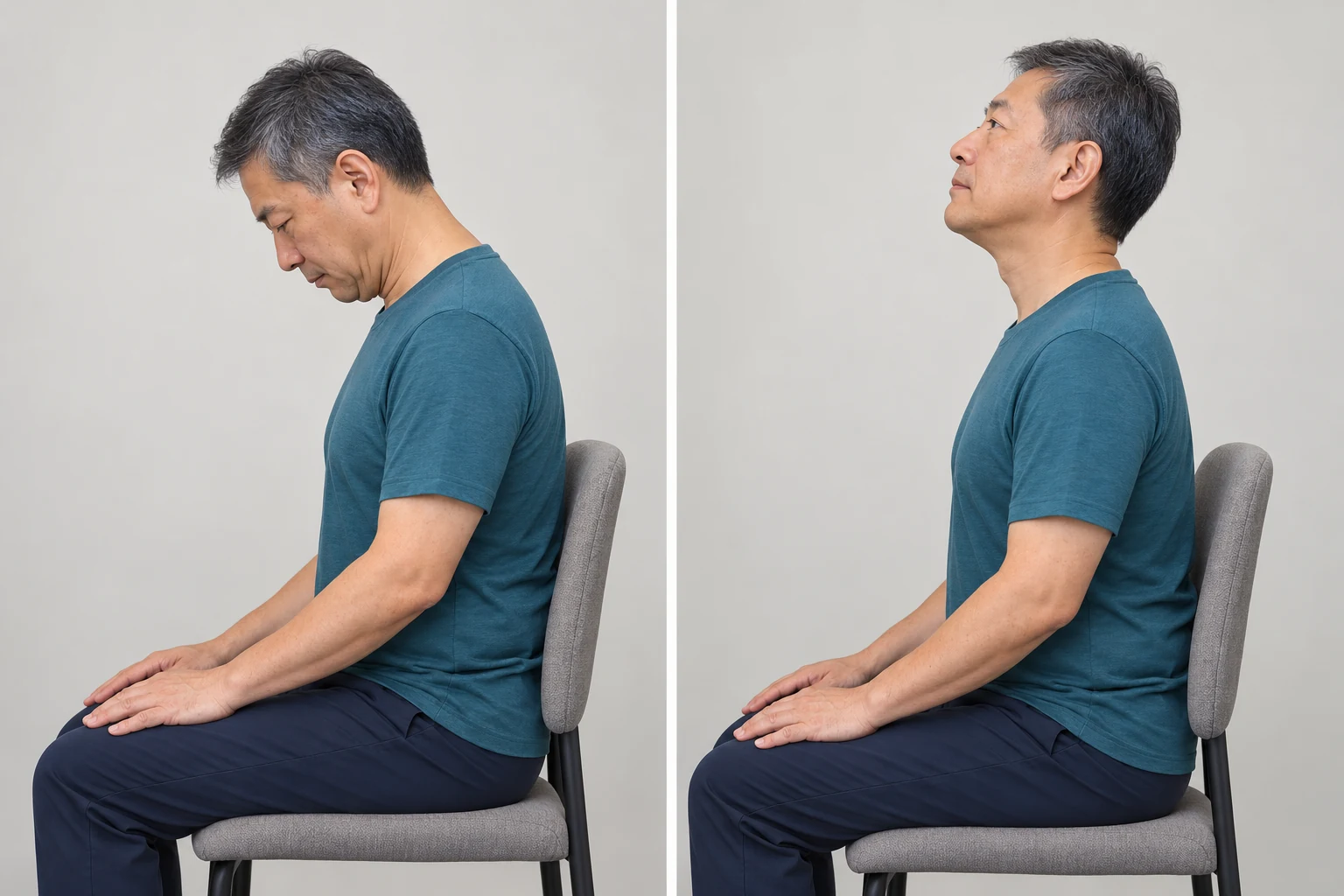
- Sit supported and start looking straight ahead.
- Slowly lower your chin towards your chest only as far as comfortable, then return to neutral.
- Look slightly upwards, then return to neutral. Keep the movements separate; do not roll your neck in a circle.
Make it fit: Leave out a direction that consistently aggravates symptoms and seek advice if it causes dizziness or new arm symptoms.
- Starting amount
- 1 set
- Repetitions / time
- 3–5 each direction
- Frequency
- Once daily to start
Optional strengthening · Exercise 5 of 6
Supported bent-over row
Build upper-back and shoulder capacity for lifting and carrying.
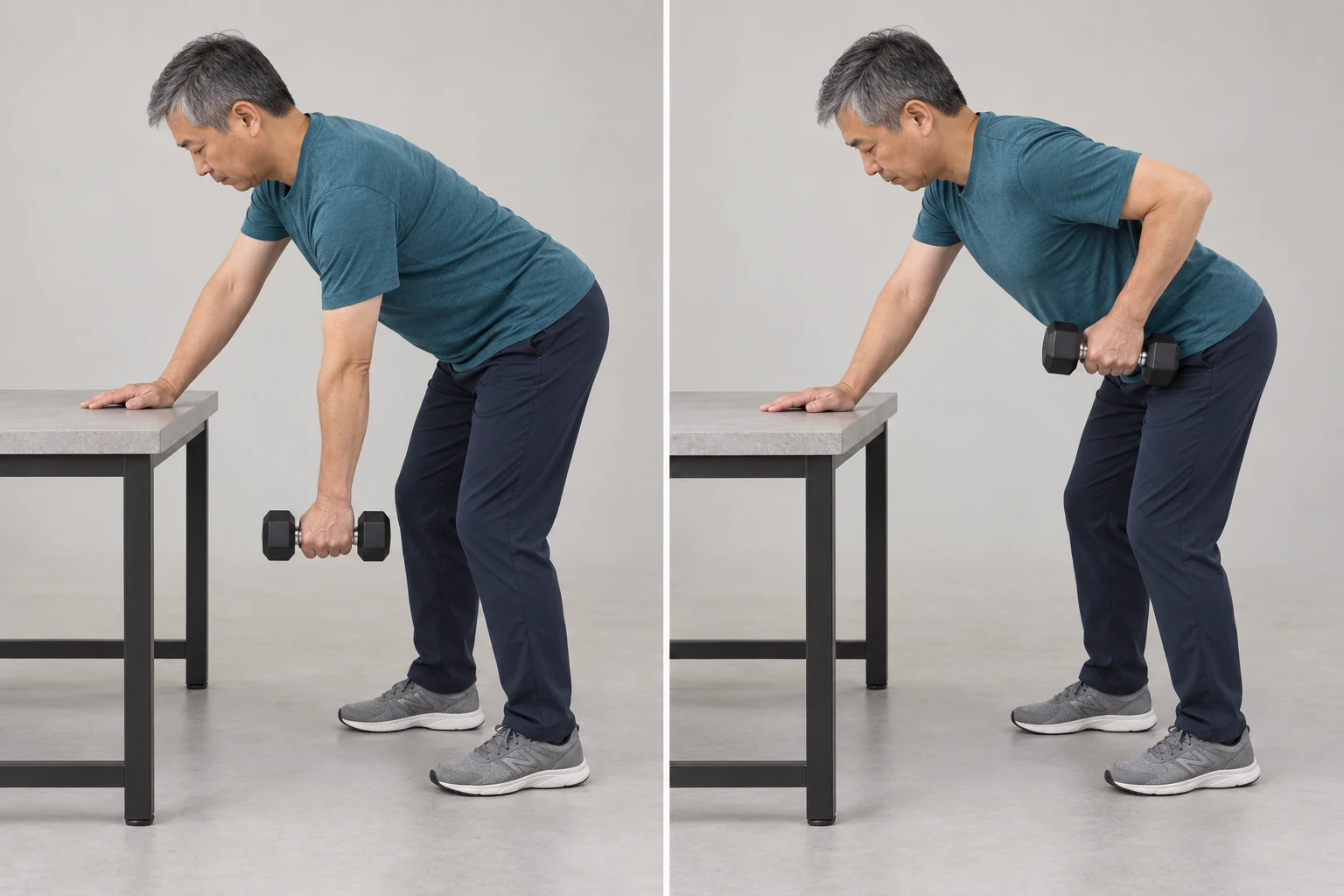
- Place one hand on a stable counter. Soften your knees and hinge forwards from your hips, with your neck in line with your back.
- Hold a light weight in the free hand. Draw your elbow backwards beside your ribs towards your waist without shrugging.
- Lower slowly and breathe normally. Repeat on the other side if comfortable; a long hold at the top is not needed.
Make it fit: Begin without a weight or use a very light bottle. Use a supported seated row instead if hinging is uncomfortable.
- Starting amount
- 1 set
- Repetitions / time
- 5–8 each arm
- Frequency
- 2–3 non-consecutive days a week
Optional strengthening · Exercise 6 of 6
Low upright row
Offer another light shoulder-girdle exercise when this movement is comfortable and relevant to your goals.
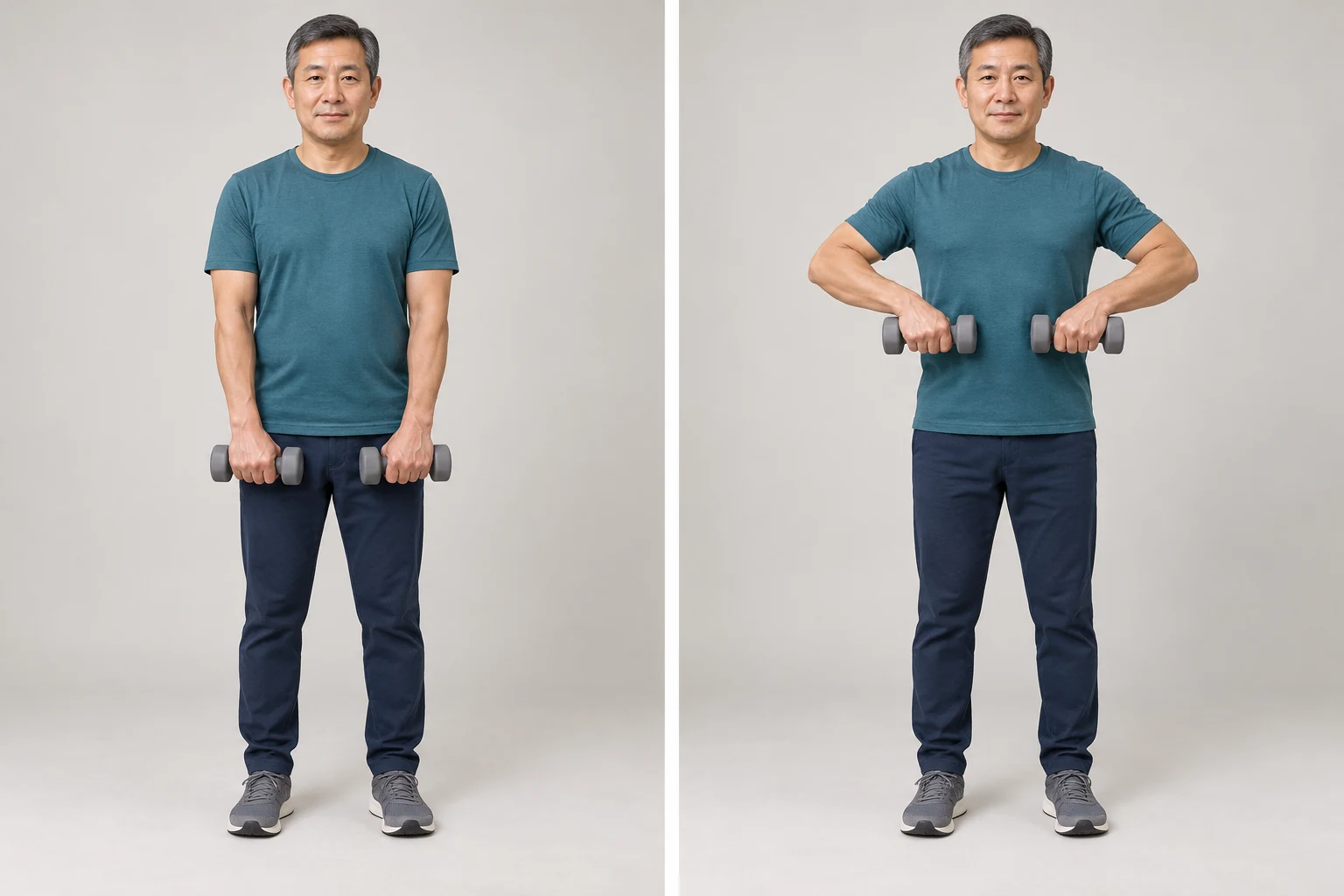
- Stand steadily with very light weights in front of your thighs, palms towards your body.
- Bend your elbows and raise the weights a short way towards your upper abdomen or lower chest. Keep your elbows below shoulder height and your neck relaxed.
- Lower slowly. Do not pull the weights up to your chin or force through shoulder pain.
Make it fit: This exercise is optional. Choose the supported row instead if it provokes the neck or shoulder; you do not need to perform both.
- Starting amount
- 1 set
- Repetitions / time
- 5–8
- Frequency
- 2–3 non-consecutive days a week
Progression
Build movement first, then add useful strength.
If symptoms settle well over several sessions, add one or two repetitions towards about 8–10 comfortable movements. For the rows, build repetitions before adding a second set or slightly more resistance. Change one feature at a time. Faster turns, deeper stretches and heavier weights are not automatic goals.
Look for improvement in tasks that matter to you, such as turning to look around, working at a desk, carrying shopping or sleeping comfortably. Repeated flare-ups or little progress are reasons to review the diagnosis and programme. Read about neck pain assessment and treatment in Hull.
Resolve MSK Clinic · Hull & East Riding
Build a programme around your everyday activities.
At 44 Bond Street, Hull, assessment considers your symptoms, movement, strength and the demands of work, home or sport. We can adjust exercise selection, check technique and plan progression around your goals.
See what an appointment involves on our private physiotherapy in Hull page, or find the clinic on Bond Street.
Sources and image credits
Where this advice comes from.
Exercise selection adapted from Pure Physiotherapy's Non-specific Neck Pain: Early Programme and Advanced Programme, supplied for this guide. Instructions have been rewritten and the range and starting amounts adjusted for general public advice. The images are newly AI-generated demonstrations using fictional adult models; they do not reproduce the people or photographs in the original sheets.
Changes from the sheets include slow rotation rather than building speed, active side bending without hand pulling, smaller starting volumes, no mandatory 10-second row holds, and a lower, optional upright row. These adaptations are not a claim that this exact combination has been tested in a clinical trial.
- Dynamic Health NHS physiotherapy: neck pain, exercises and safety advice
- NHS Inform: exercises for neck problems and symptom-guided progression
- NHS: neck pain and everyday activity advice
Evidence and source sheets checked 5 October 2026. General information, not an individual diagnosis or prescription. Review due October 2027, or sooner if guidance materially changes.