
The starting point
Choose a manageable level.
These five movements are options rather than a routine that everyone must complete. Begin with one or two that feel comfortable. The response in your leg matters more than how far you move or how many exercises you finish.
NICE recommends advice that supports self-management and continued normal activity, with exercise selected around the person's needs, preferences and capabilities. No single stretch treats every cause of sciatica. Read the clinical guideline.
A mild stretch or comfortable movement is enough. Do not force a position or push through increasing leg pain. If a movement makes pain travel further down the leg, increases tingling or numbness, or leaves you clearly worse afterwards, stop that exercise and seek individual advice.
Before you start
Let the leg symptoms guide the movement.
Try one set of a few slow movements first. Break up long periods of sitting with comfortable changes of position or short walks where possible. Exercises that ease the back but make symptoms spread further down the leg may still be too provocative.
Reduce the range or repetitions if symptoms build. Stop an exercise if it produces sharp or electric pain, increasing numbness or weakness, or a worsening response that does not settle after you stop.
Go to A&E or call 999 for numbness around the genitals or bottom, new difficulty passing urine, loss of bladder or bowel control, sciatica on both sides, or severe or worsening weakness or numbness in both legs. Seek prompt medical advice for new or worsening weakness in one leg.
Exercise 1 of 5
Single knee-to-chest stretch
Explore a gentle lower-back movement while the other leg remains supported.
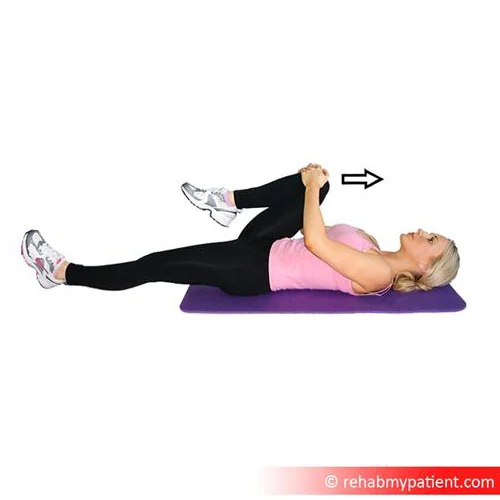
- Lie on your back on a bed or mat, with both legs in a comfortable position.
- Bend one knee and gently draw it towards your chest with your hands.
- Pause at a light stretch, then release slowly. Try the other side only if it feels comfortable.
Make it fit: Use a smaller movement or keep the other knee bent. Stop if this causes groin pain or makes symptoms travel further down the leg.
- Starting amount
- 1 set
- Repetitions / time
- 3–5 each side
- Frequency
- Little and often if comfortable
Exercise 2 of 5
Gentle lumbar rotation
Practise relaxed side-to-side movement through the lower back.
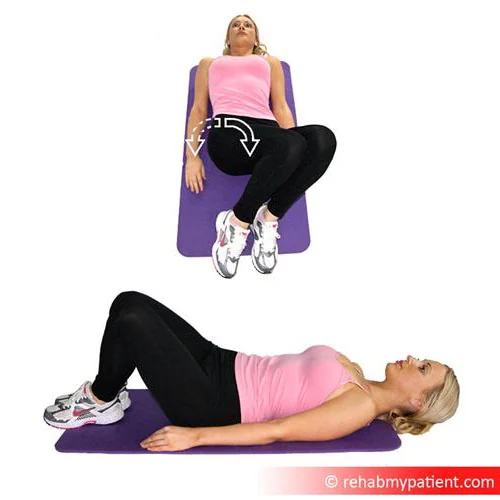
- Lie on your back with both knees bent and your feet resting on the bed or floor.
- Slowly let your knees move a small distance to one side, then return to the middle.
- Move towards the other side without forcing your knees towards the floor.
Make it fit: Make the range smaller if your back or leg becomes more irritable.
- Starting amount
- 1 set
- Repetitions / time
- 5–8 each way
- Frequency
- Little and often if comfortable
Exercise 3 of 5
Child's pose
Explore comfortable bending and lengthening through the back.
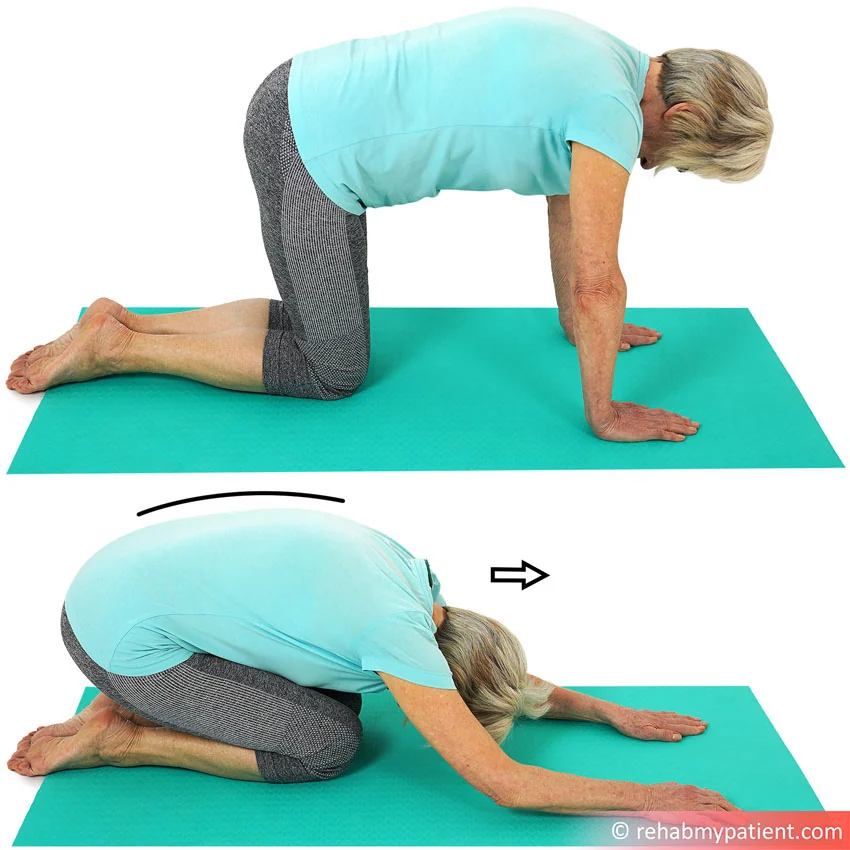
- Kneel on a mat or bed with your hands in front of you.
- Gently move your hips back towards your heels while your arms slide forwards.
- Stop at a comfortable stretch, then return slowly. You do not need to sit fully on your heels.
Make it fit: Skip this exercise if kneeling troubles your knees or bending forwards increases the leg symptoms.
- Starting amount
- 1 set
- Repetitions / time
- 3–5 slow movements
- Frequency
- Once or twice daily to start
Exercise 4 of 5
Seated forward bend
Try a small, relaxed bending movement while seated.
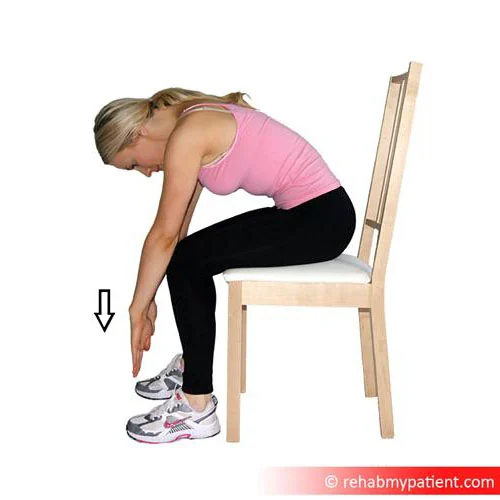
- Sit on a stable chair with both feet supported on the floor.
- Let your upper body and arms relax forwards a short distance, allowing a gentle rounding through the back.
- Pause briefly, then use your hands on your thighs if needed to return upright slowly.
Make it fit: This is not a test of how far you can reach. Leave it out if bending sends pain further down the leg.
- Starting amount
- 1 set
- Repetitions / time
- 3–5 slow movements
- Frequency
- Once or twice daily to start
Exercise 5 of 5
Seated sciatic nerve glide
Introduce gentle movement around sensitive neural tissue without holding a strong stretch.
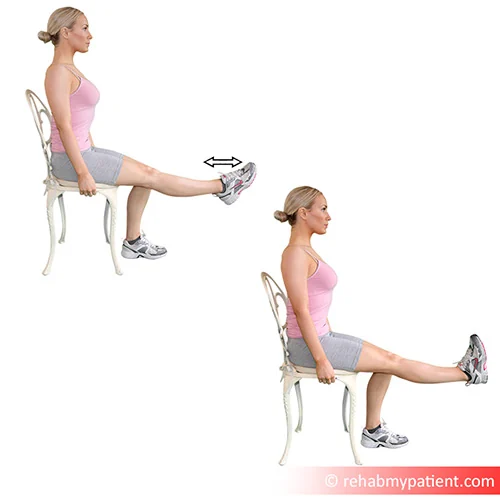
- Sit upright on a stable chair.
- Slowly straighten the affected leg only until you are comfortably short of provoking pain.
- Gently move the ankle up and down, then lower the leg again. Keep the movement smooth.
Make it fit: Stop if this reproduces sharp, electric or worsening leg pain, or if symptoms remain worse after you finish.
- Starting amount
- 1 set
- Repetitions / time
- 5 gentle movements
- Frequency
- Once or twice daily to start
Progression
Keep the movements comfortable and build normal activity gradually.
When a movement feels manageable and symptoms settle afterwards, add one or two repetitions or practise it slightly more often. Change one feature at a time. Walking, sitting tolerance, strength and the demands of work or exercise may also need to be rebuilt as recovery progresses.
Progress should also help a useful task: reaching a shelf, dressing, using tools or returning to sport. Repeated flare-ups or little progress are reasons to review the diagnosis and programme. Read about sciatica assessment and treatment in Hull.
Resolve MSK Clinic · Hull & East Riding
Build a programme around your everyday activities.
At 44 Bond Street, Hull, assessment considers your symptoms, movement, strength and the demands of work, home or sport. We can adjust exercise selection, check technique and plan progression around your goals.
See what an appointment involves on our private physiotherapy in Hull page, or find the clinic on Bond Street.
Sources and image credits
Where this advice comes from.
CHCP MSK Physiotherapy: Sciatica — EASY, dated 13 March 2023. The five displayed exercises and original Rehab My Patient illustrations are reproduced from the supplied sheet with the visible copyright credits retained.
The source sheet advises a little-and-often approach. The cautious starting amounts below are general examples. You do not need to do every movement, and an individual assessment may lead to different exercise choices.
- NICE NG59: Low back pain and sciatica in over 16s
- NHS: Sciatica
- Cambridge University Hospitals: Neural mobility exercises
Evidence and source sheets checked 29 September 2026. General information, not an individual diagnosis or prescription. Review due September 2027, or sooner if guidance materially changes.